
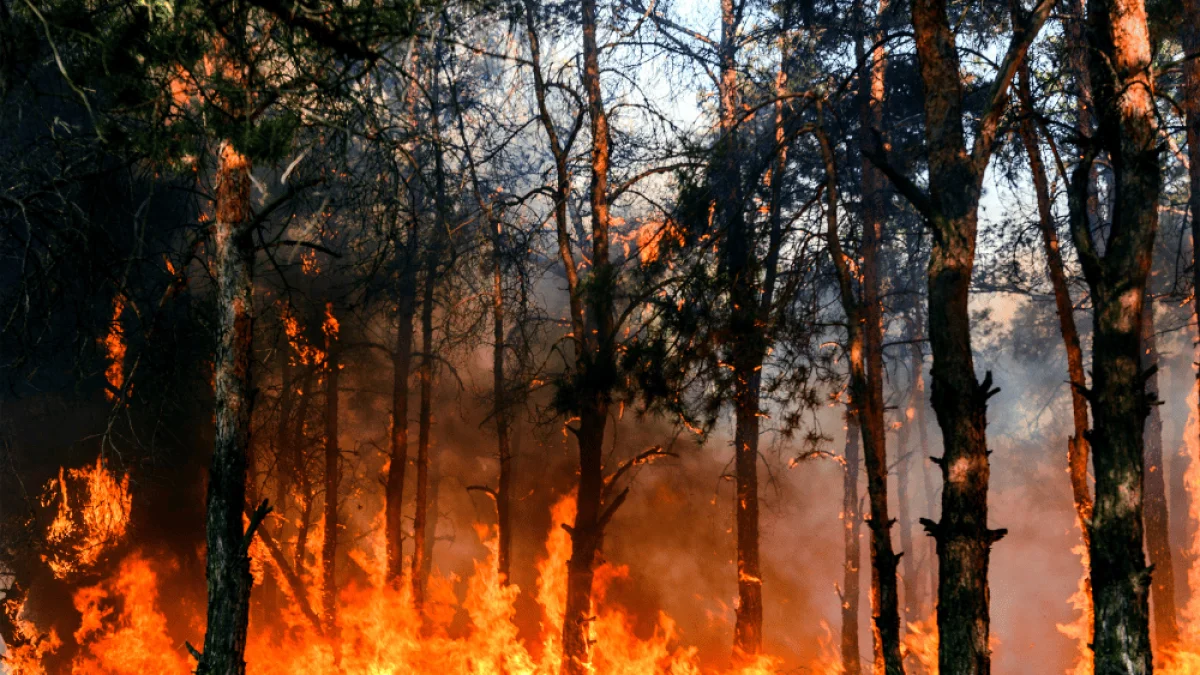
Wildland fire managers are describing 2026 as a “fire year,” not a short seasonal spike. Through 11 June, the National Interagency Fire Center (NIFC) reported 32,183 fires that had burned roughly 1,019,000 hectares (2.52 million acres) nationwide — about 80% more area than the 10-year average to date of 565,000 hectares (1.4 million acres) on 23,478 fires. The country remains at National Preparedness Level 2, with large fires still spreading in the South, Rockies and parts of the East while drought and dry fuels keep much of the West on edge.
National Interagency Coordination Center Manager Sean Peterson warned earlier this year that an extremely dry winter across the western United States had raised the odds of serious fires in 2026 — a forecast that is already playing out as Southern Plains states that often produce the nation’s largest wildfires report early-season outbreaks.
2025 was quieter on acreage — but not on impact
The current surge follows a 2025 season that looked milder on paper. The coordination center tallied 77,850 wildfires burning about 2.02 million hectares (5 million acres) in 2025, compared with 67,897 fires and nearly 3.64 million hectares (9 million acres) in 2024. Total acreage in 2025 fell below the 10-year average of roughly 3.08 million hectares (7.6 million acres), largely because frequent spring and early-summer rain suppressed fire activity in the Southern United States — a region that typically accounts for some of the country’s biggest burns.
Yet several 2025 fires rewrote the public narrative. The concurrent Eaton and Palisades fires in the Los Angeles area in January 2025 produced the most destructive 48-hour disaster in recorded California history, even as national acreage totals stayed subdued. The Dragon Bravo Fire on the Grand Canyon’s North Rim destroyed the historic Grand Canyon Lodge in September. Peterson noted that headline-grabbing urban-interface fires can make a year feel far worse than aggregate statistics suggest — a pattern that keeps communities, utilities and emergency planners focused on ignition risk long before peak summer.
Why drought is driving the escalation
Fire weather does not start at the first spark — it builds when fuels, humidity and wind align. NIFC’s June national outlook notes that about 61% of the United States was in drought as of late May, with independent climate assessments putting continental U.S. drought coverage closer to 62% by early June. Months of below-normal precipitation and above-normal temperatures have cured grasses, shrubs and timber at lower elevations, while snowpack deficits in parts of the Rockies and Great Basin left upper slopes drier than usual heading into summer.
That combination means ignitions — whether from lightning, equipment or human activity — can run faster and farther before crews can contain them. Forecasters warn that without a sustained pattern change, the core of the western fire season could arrive earlier and burn more intensely than recent averages suggest. Peterson cautioned that seasonal outlooks can shift quickly: at this point in 2025, forecasters had flagged major Southern fire potential after a wet fall built up fuel — but continued rains through spring kept many of those fires from materialising.
Where the acres are piling up
Regional totals through 11 June show how broad the problem has become:
- Rocky Mountain Area: about 470,000 hectares (1.16 million acres) — the largest regional total, with Colorado, Wyoming and neighbouring states carrying much of the load.
- Southern Area: about 404,000 hectares (998,000 acres) — an unusually heavy tally for the Southeast, where Florida Panhandle and Georgia fires have contributed large acreage this spring.
- Southwest Area: about 51,000 hectares (126,000 acres), with New Mexico’s Seven Cabins fire among the notable large incidents at more than 12,900 hectares (31,900 acres).
- Eastern Area: about 28,000 hectares (70,000 acres) — elevated for a region that often sees smaller, shorter-duration burns.
- Great Basin: about 22,000 hectares (54,000 acres), with red-flag wind events already testing containment lines.
Alaska, the Northwest and Northern Rockies have reported smaller totals so far, but NIFC’s outlook flags increasing large-fire potential there as summer heat builds and lightning clusters arrive. California — scarred by January 2025’s urban-interface catastrophes — faces elevated odds again after the dry winter Peterson highlighted, with grasses and chaparral curing weeks ahead of typical schedules.
Red-flag winds and the weeks ahead
June outlooks highlight elevated to critical fire weather across parts of the Great Basin, Rocky Mountain region and interior California when dry cold fronts sweep through. Forecasters expect gusts of 30–45 km/h (20–30 mph), relative humidity dropping into the single digits or low teens, and temperatures climbing above seasonal normals — a recipe for rapid fire growth on slopes already primed by drought.
At Preparedness Level 2, federal and state agencies are sharing aviation, crews and equipment nationally but have not yet reached the highest surge posture. Even so, incident command teams are juggling multiple large fires across time zones, and any burst of lightning without soaking rain could quickly push demand higher.
What officials are watching through summer
NIFC’s monthly outlook points to above-normal significant fire potential from the Southwest through the central and northern Rockies into parts of the Pacific Northwest and northern Great Basin as June turns to July. Southern California, the Sierra Nevada foothills and portions of the northern Plains are also on watch lists as grasses cure and monsoon moisture remains uncertain in the Desert Southwest.
For communities far from active flames, smoke transport remains a secondary hazard: plumes from Western and Southern fires have already degraded air quality hundreds of kilometres downwind, a pattern likely to repeat whenever wind aloft aligns with population centres.
Track active fires on SatMeteo
As the 2026 season shifts from spring outbreaks to a sustained national fire year, near-real-time situational awareness matters for residents, travellers and emergency planners. Use the live active fire map on SatMeteo to monitor hotspots, recent detections and fire activity across the United States and worldwide — updated as satellite and agency data flows in.