





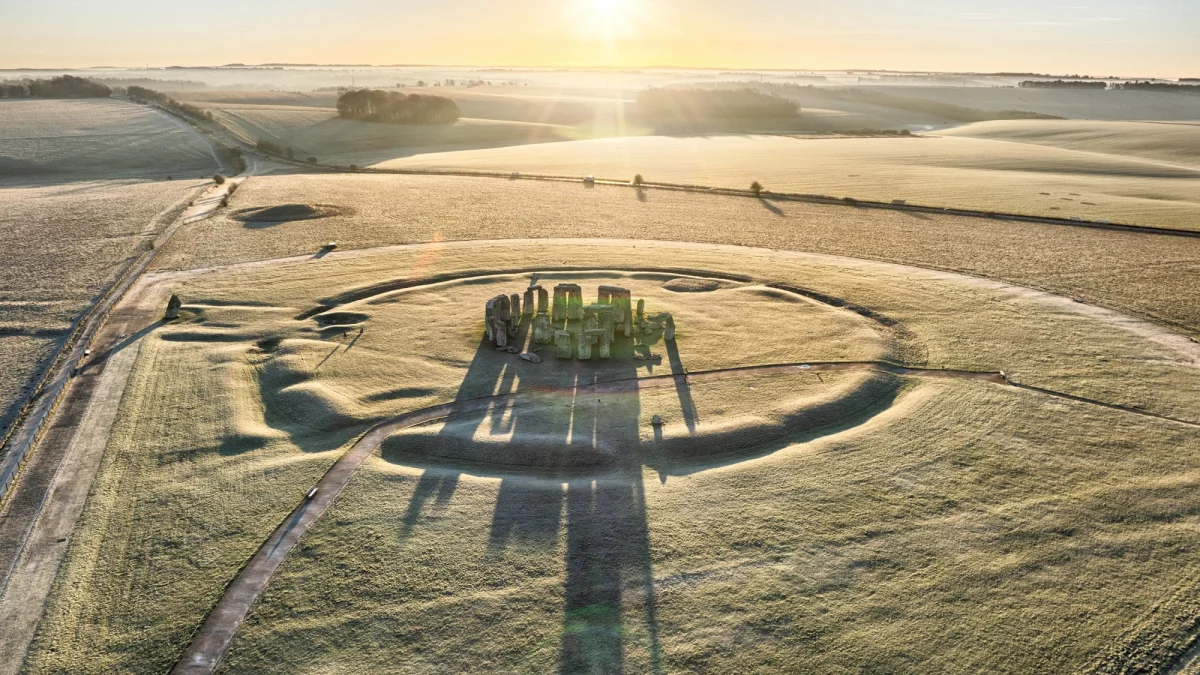
Three miles east of Britain's most famous prehistoric monument, on a hillside overlooking the modern village of Bulford in Wiltshire, archaeologists have identified what they describe as an earlier and simpler forerunner to Stonehenge — two massive wooden posts, sunk into the ground around 2950 BC, aligned to mark the summer solstice sunrise and the winter solstice sunset. Announced by Wessex Archaeology on 18 June 2026, just days before this year's solstice gatherings, the find suggests communities on Salisbury Plain were tracking the sun's seasonal journey at least 500 years before the great sarsen stones were raised.
Two posts, one sightline
The structure was not stone. It was timber — long since rotted away — but the post pits remain. Researchers uncovered two large pits roughly 120 metres (400 ft) apart on a hillside about 5 km (3 miles) northeast of Stonehenge. Unlike dozens of other pits at the site, these two tapered toward the bottom — from about 1.2 metres (4 ft) across at the top to 0.5 metres (20 in) — and were filled with chalk rubble rather than domestic debris, a signature of upright timbers held in place by packed stone.
When archaeologist Phil Harding drew a line between the two pits, the significance became clear. The sightline runs parallel to the solstice alignments at Stonehenge itself: pointing directly at the spot where the first rays of the midsummer sun would break the horizon, and — in the opposite direction — at the winter solstice sunset. "We didn't grasp the significance of the post pits at first," Harding told National Geographic. "It wasn't until we drew a line between them and noticed that it was exactly parallel with the solstice sightlines at Stonehenge."
Radiocarbon dating of pottery, flint tools, animal bones and charcoal from 48 pits across the site places activity around 2950 BC — contemporary with the earliest earthworks at Stonehenge, when the great circular henge was being dug but before the famous stones were aligned to the solstices.
Proof in the sky
To confirm the alignment was deliberate rather than coincidence, Wessex Archaeology recruited Dr Fabio Silva, a skyscape archaeologist at consultancy Stone x Sky. Using a 3D reconstruction of the ancient landscape with modern buildings removed, plus data on how the sun's path has shifted over five millennia, Silva calculated that the posts aligned with both solstices to within about one degree — and effectively "bang on" once the width of the timbers (up to 50 cm (20 in)) was taken into account.
"The odds of this being by chance are less than 0.5 per cent," Silva said at the announcement. "The alignment shows that communities were already engaging with both the summer and winter solstices in the Stonehenge landscape, centuries before the sarsen stones were raised." The Bulford discovery is among the earliest known examples in the British Isles of a monument built specifically to track an astronomical phenomenon.
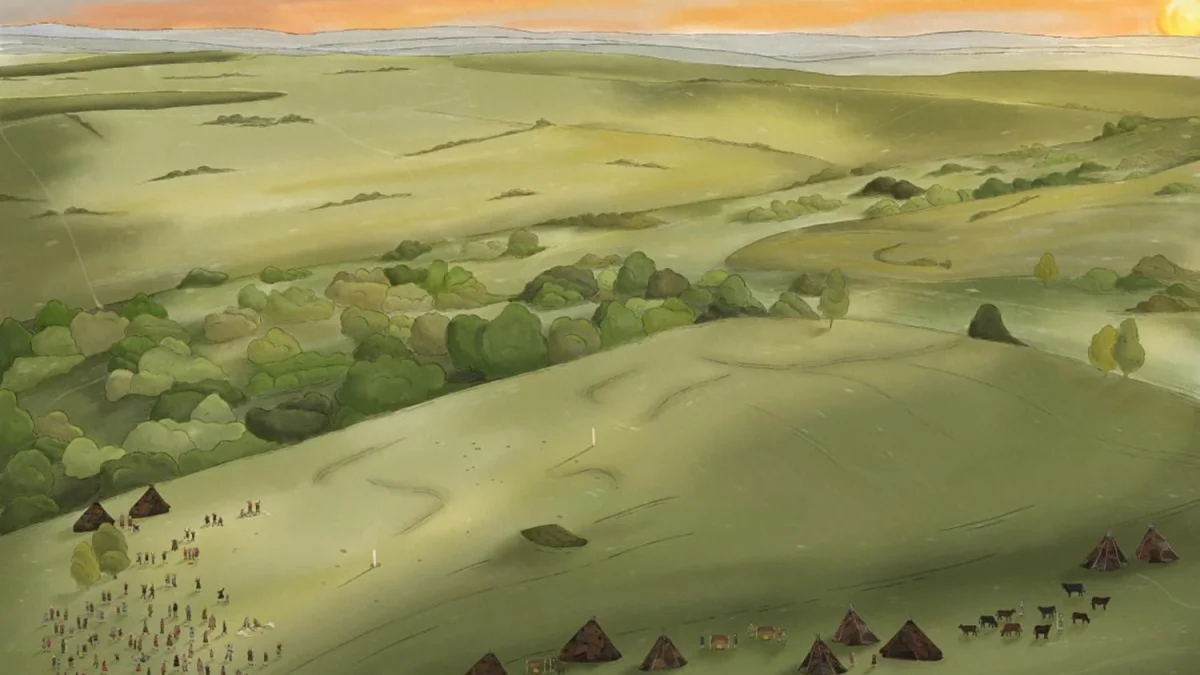
Near the post pits, archaeologists found evidence of feasting: pottery sherds, worked flints including a rare disc-shaped flint knife, and animal bones. The pattern suggests Bulford was a gathering place — a focal point for ceremonies linked to the turning of the seasonal calendar, not merely a construction site.
From wood to stone
Stonehenge itself went through multiple phases. The earliest monument, dated to around 3000 BC, consisted of a circular bank and ditch with an arrangement of timber posts — but at that stage it was not yet aligned to the solstices. The great sarsen trilithons and bluestones, carefully positioned to frame the midsummer sunrise above the Heel Stone and the midwinter sunset through the central axis, came later — around 2500 BC.
What Bulford reveals is a stepping stone: a much simpler wooden construction on a nearby hillside, built by the same farming communities who depended on the sun for crops and livestock, marking the same celestial events half a millennium earlier. "Up till now, our knowledge of this ancient feat of astronomy was based on Stonehenge and other monuments of a similar period," Harding said in the Wessex Archaeology release. "But what we've discovered at Bulford is 500 years earlier than the famous stones we know so well."
Jennifer Wexler, curator of history at English Heritage, which manages Stonehenge, noted that prehistoric farmers needed the sun "to do its job" for agriculture — and that solstice celebrations likely carried deep symbolic meaning beyond practical calendrics. "The regenerative power of the sun could have been connected with ideas about the afterlife," she told NBC News. "But social cohesion and bringing people together could also have been one of the purposes for such monuments."
A dig born of army housing
The excavation itself was unglamorous in origin. Between 2015 and 2017, Wessex Archaeology surveyed Bulford as part of archaeological work supporting the UK Ministry of Defence's programme to expand troop housing on Salisbury Plain, as personnel were withdrawn from Germany. There was nothing visibly remarkable on the surface — just soil traces and scattered pits. Years of analysis followed before the team felt confident enough to announce the solstice alignment.
Harding, familiar to British viewers from the Channel 4 series Time Team, called the discovery "one of the greatest finds" of his career — "ecstatic, but cautious," as he told NBC News, because the team had to be "absolutely certain" before going public.
Solstice 2026: same sun, same plain
The timing of the announcement is no accident. On Sunday 21 June 2026, thousands of people are expected to gather at Stonehenge for the summer solstice — the longest day of the year in the Northern Hemisphere. Visitors standing at the centre of the stone circle will watch for the sun to rise above the Heel Stone to the northeast — weather permitting.
"What few will realise is that 5,000 years ago on a nearby hillside overlooking modern-day Bulford, people were doing the exact same thing — revering and celebrating the sunrise on Midsummer's Day," Harding said. English Heritage opens the monument for managed solstice access; the exact arrangements and crowd limits vary year to year, but the astronomical moment remains unchanged: sunrise at its northeasternmost point on the horizon.
Weather and the solstice sunrise
On Salisbury Plain, seeing that sunrise is never guaranteed. Salisbury in late June typically offers long daylight — roughly 16 hours between astronomical dawn and dusk — with afternoon highs often reaching 20–24°C (68–75°F) and moderate humidity. But the plain is exposed: low cloud, mist and ground fog can roll in overnight and linger through the 04:30–05:00 sunrise window, wiping out the horizon even when the sky clears by mid-morning.
For solstice watchers, the critical forecast is not the afternoon high but the pre-dawn cloud base and visibility between 04:00 and 05:30 local time. A high overcast deck above 300 metres (1,000 ft) may still allow a visible solar disk at the horizon; a thick fog layer at ground level will not. Westerly winds ahead of an Atlantic front can bring patchy drizzle and reduced contrast; a ridge of high pressure settling over southern England offers the best odds of a clean northeastern horizon.
Even partial cloud can produce a dramatic spectacle — crepuscular rays fanning across the plain as the sun breaches a gap — but photographers and druids alike know that Salisbury Plain rewards early risers who check the forecast the night before. Pack layers: pre-dawn temperatures in mid-June often dip to 10–13°C (50–55°F) even when the afternoon turns warm.
Why the sun still matters
Five millennia after the Bulford posts were erected, the solstice remains a bridge between ancient astronomy and modern life. The monument UNESCO called "the most architecturally sophisticated prehistoric stone circle in the world" still draws visitors from across the globe — and the wooden prototype three miles away reminds us that the impulse to mark the sun's turning point is far older than the stones themselves.
Whether you are planning a trip to Wiltshire for solstice sunrise or simply watching the year's longest day from home, the same celestial mechanics that guided Neolithic farmers — sunrise at its northernmost gate, sunset at its southernmost — govern the season ahead. Track hourly conditions for Salisbury and across the UK on SatMeteo, and use the live temperature map to follow how June warmth builds across southern England in the days around the solstice.