
Nearly half of the world's children — about 1.1 billion — are now exposed to at least three overlapping climate hazards that threaten their health, education and survival, according to The Children's Climate Risk Report 2026, published by UNICEF on 16 June 2026. Almost every child on Earth faces at least one such hazard, the agency warned, while more than 4 million could confront as many as six overlapping threats at once.
"The lives of children continue to be upended by the impact of heatwaves, wildfires, droughts, and floods," said UNICEF Executive Director Catherine Russell. "Half of the world's children are now living with at least three overlapping climate threats shaping their daily lives."
What the report measures
For the first time, the report maps exactly where — and how intensely — multiple climate threats overlap for children and the essential services they rely on. Analysts used pixel-level, multi-hazard modelling at resolutions as fine as 100 square kilometres (39 sq miles) in each country, with some hazards mapped at 100-metre (328 ft) scale — a major upgrade from UNICEF's 2021 climate risk assessment.
The study tracks exposure to eight frequent climate hazards: coastal floods, droughts, extreme heat, fires, heatwaves, riverine floods, sand and dust storms, and tropical storms. It also examines two climate-sensitive risks — air pollution and malaria — layered on top of physical climate shocks.
Methodologists used a probabilistic model based on a 100-year return period to estimate how often extreme events children are likely to encounter over their lifetimes, then combined hazard exposure with vulnerability across seven dimensions: water, sanitation and hygiene, nutrition, protection, health, education, poverty and child survival.
Overlapping hazards at global scale
Climate threats rarely arrive alone. The most widespread combination globally is drought, extreme heat and heatwaves, affecting more than 296 million children simultaneously. The second most common trio — drought, extreme heat and tropical storms — leaves more than 115 million children exposed to all three at once.
Beyond the headline figure of 1.1 billion children facing three or more hazards, UNICEF estimates that:
- 1.8 billion children are at risk from drought
- 1.2 billion are exposed to extreme heat
- More than 1.5 billion face frequent and severe heatwaves
- More than 360 million are exposed to flooding
- 2.3 billion live in areas with unhealthy air quality
- 1 billion are exposed to malaria
Without urgent cuts to greenhouse gas emissions, these hazards are expected to grow more frequent and severe, placing greater strain on government budgets and the social systems children depend on.
Regional hotspots
South Asia stands out for both the number and intensity of overlapping hazards. Children in Dhaka, Karachi and across Bangladesh, Myanmar and Pakistan face more climate hazards at once — and at higher intensity — than anywhere else in the world.
In the Sahel region of Africa, more than 4 million children confront the triple threat of heatwaves, extreme heat and sand and dust storms. Landlocked and fragile states such as the Central African Republic and Chad combine overlapping climate shocks with weak access to basic services, making recovery far harder.
All children in 24 Small Island Developing States, from Haiti to Vanuatu, are exposed to tropical storms that can disrupt entire islands at once and overwhelm health and education infrastructure.
High-income countries are not immune. In Rome, more than 6 million children are exposed to prolonged heatwaves and drought — illustrating how overlapping climate shocks reach wealthy nations even where adaptation investments have begun to reduce some risks.
When infrastructure fails
UNICEF highlighted how extreme weather is stressing roads, bridges and schools with direct consequences for children's daily lives. In Papua New Guinea's Rigo district, a footbridge over the Kemp Welch river washed away during heavy rains in 2012 and was never replaced. Hundreds of children now swim across the crocodile-filled river each day to reach school; during monsoon season, heavy currents, debris and cold, dirty water cause illness and widen learning gaps, especially for girls.
Lorna, 15, told UNICEF staff that elders sometimes bar girls from crossing during menstruation out of fear of attracting crocodiles. "My dream is to become a teacher or pilot," she said. "We want a new bridge so we can go to school safely every day."
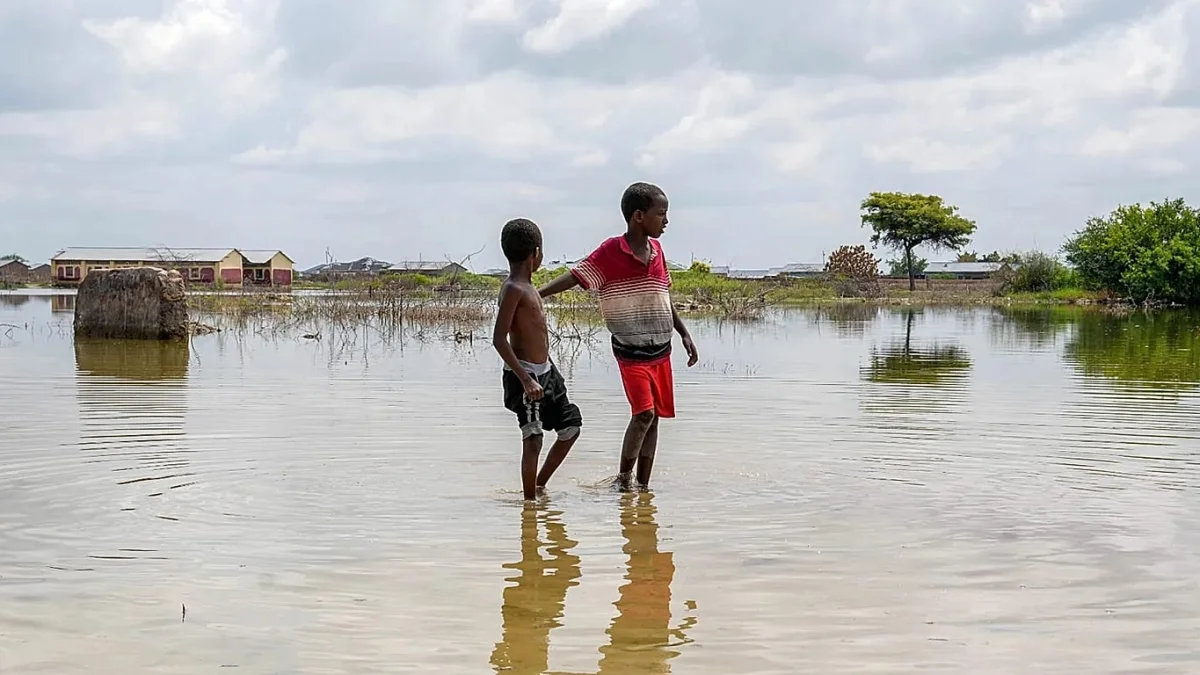
Similar patterns play out wherever floods undermine transport and sanitation. In Nairobi's Mandera County and across East Africa, saturated fields and overwhelmed drainage leave communities — and the children who walk through them — navigating deep floodwater long after rains peak, as shown in the photograph above.
Health and development impacts
Children are disproportionately vulnerable to climate-related hazards. Their bodies are still developing: they sweat less per kilogram of body weight, heat up faster during extreme temperatures, and their lungs and immune systems remain immature until early adulthood, making air pollution and vector-borne disease especially dangerous.
Heat stress raises risks of preterm birth, congenital anomalies and pregnancy complications. Flooding contributes to drowning, injuries, mould-related respiratory illness and outbreaks of diarrhoea, cholera and malaria when water and sanitation systems fail. Wildfires and drought can cascade — dry vegetation fuels fires that worsen air quality, leaving land vulnerable to flash floods that spread waterborne disease later in the year.
The report stresses that impacts on children's physical and mental health, well-being and access to education remain enormous yet poorly quantified in many countries — a gap UNICEF says better hazard mapping can help governments close.
UNICEF's call to action
To protect children's rights from escalating climate threats, UNICEF urged governments, businesses and international partners to:
- Reduce emissions and fulfil existing international commitments, including phasing out fossil fuels and accelerating a just transition to renewable energy
- Protect children through inclusive climate adaptation and disaster risk reduction that prioritises resilient health, education, water and food systems — including safe learning facilities, climate-resilient hospitals and multi-hazard early warning systems designed for children
- Empower children and young people to participate meaningfully in climate decisions through climate education and strengthened capacity for decision-makers to respect children's right to be heard
"This analysis can help governments and decision-makers plan better and invest more effectively in resilient services," Russell said. "When we strengthen health and education systems, and improve infrastructure with children in mind, we protect them from today's climate threats and help secure their future."
Track climate hazards on SatMeteo
Heatwaves, flood risk and storm patterns shift week by week across the regions UNICEF identifies as hardest hit. Check forecasts for Rome, Dhaka, Karachi, Nairobi and Maputo on SatMeteo, and use the live temperature map to monitor how extreme heat and rainfall are building in real time.