




Australia's roughly 2,000 species of native bees may cope with climate change very differently depending on one choice they made long before humans began burning fossil fuels: where to build a nest. A study published 15 June 2026 in Nature Communications tested the heat tolerance of 95 species and 3,484 individual bees collected from 16 sites spanning mainland Australia from Adelaide to Cape York. The result is a striking paradox: bees that evolved the highest tolerance to extreme heat are also the species most exposed to it — and standard methods for ranking climate risk get the answer backwards unless nest microclimates are included.
How the study worked
Led by evolutionary physiologist Carmen da Silva of Macquarie University's Pollinator Futures Research Centre, researchers spent four months sweeping flowering plants with butterfly nets from the tropical north to temperate Melbourne, sucking captured bees into collection vials with a "pooter" — a flexible tube with fine gauze that prevents accidental inhalation. Bees were kept cool and fed sugar solution before being transferred to a portable lab.
Heat tolerance was measured as CTmax — the critical thermal maximum at which a bee loses coordinated movement. Each individual was placed in a small glass vial submerged in a water bath starting at 26°C (79°F), then warmed at 0.1°C (0.18°F) per minute until movement ceased. The temperature at that point was recorded, and specimens were preserved for identification. The team drew on taxonomic keys, DNA barcoding and expert assistance from the Australian Museum and Museums Victoria to name species — including several not yet formally described.
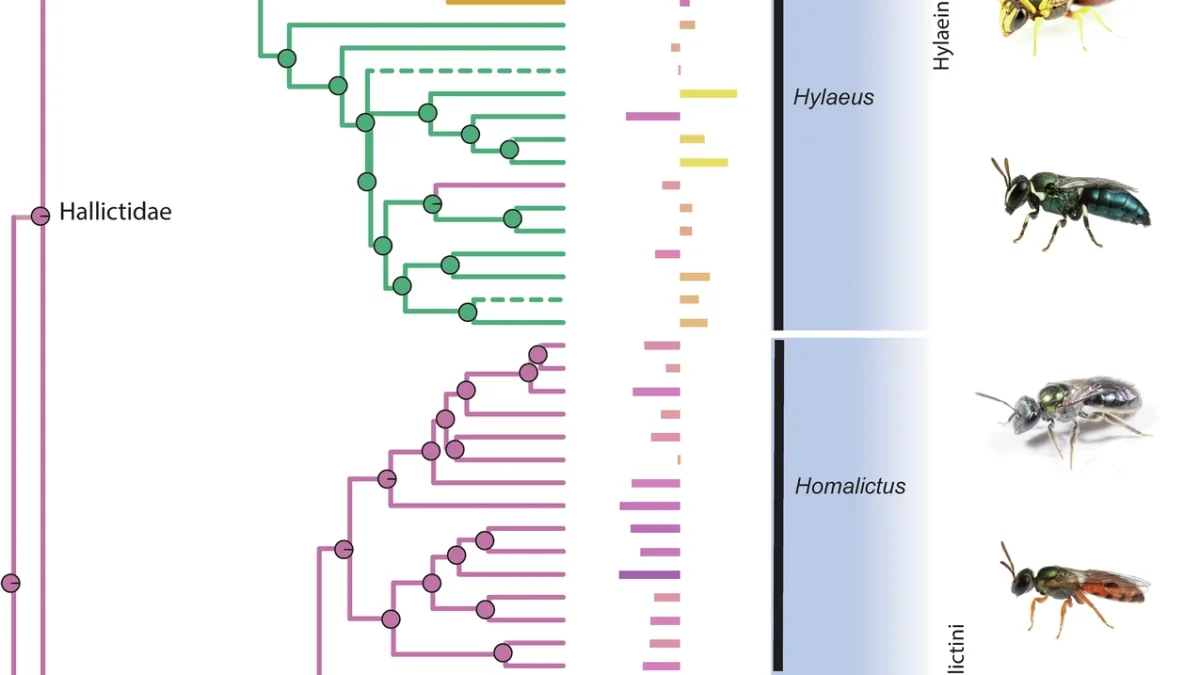
Co-authors from the University of Sydney, La Trobe University, Flinders University, the University of Wollongong, Adelaide University and the University of Queensland reconstructed an ultraconserved-element phylogeny spanning four bee families and 22 genera, allowing the team to separate evolutionary history from the effects of nesting behaviour.
Three nest types, three microclimates
Australian native bees divide broadly into three nesting strategies, each creating a distinct microclimate:
- Ground nesters (~70% of species) excavate burrows in soil, often more than 50–100 cm (20–39 in) deep. Soil buffers them from the hottest air temperatures.
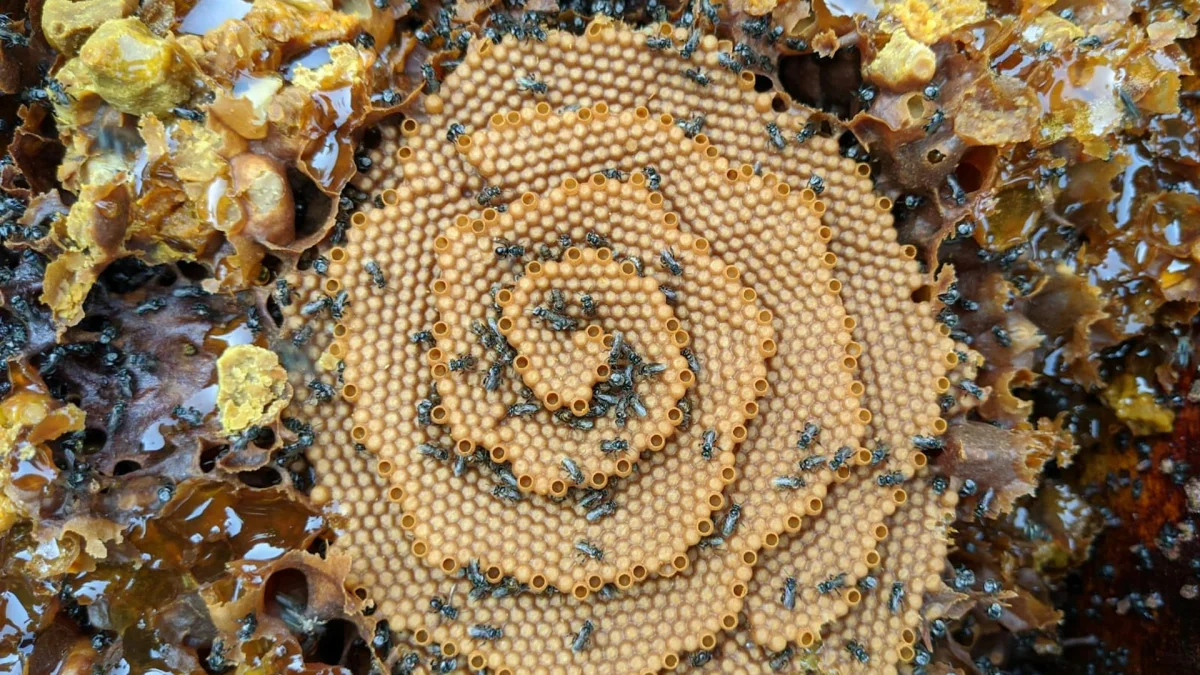
- Cavity nesters occupy tree hollows, dead wood or resin-lined chambers — including stingless bees such as Tetragonula carbonaria, whose spiral brood combs are shown above. They experience intermediate thermal exposure.
- Stem nesters use thin plant stems, twigs and narrow branches. With little insulation, these nests reach the highest internal temperatures.
The researchers modelled maximum nest microclimate temperatures for each species at every collection site, using substrate-specific estimates: soil temperature at depth for ground nesters, air temperature at 1.2 m (4 ft) for stem nesters, and an intermediate value for cavity nesters. They compared these against macro-scale climate data at 1 km² (0.4 sq miles) resolution — the standard approach in most heat-tolerance studies.
Nest microclimate beats regional climate
When the team correlated heat tolerance with macro-scale maximum temperatures and precipitation, the relationship was weak, explaining only about 6% of variation between species — consistent with decades of research suggesting heat tolerance is evolutionarily constrained or poorly matched to broad geographic climate.
But when nest microclimate temperatures were used instead, the signal strengthened markedly (R² ~0.13). Stem-nesting species were the most heat tolerant, cavity nesters intermediate, and ground nesters the least tolerant — precisely the order expected if bees adapt to the temperatures they actually experience inside their nests, a pattern known as the Bogert effect.
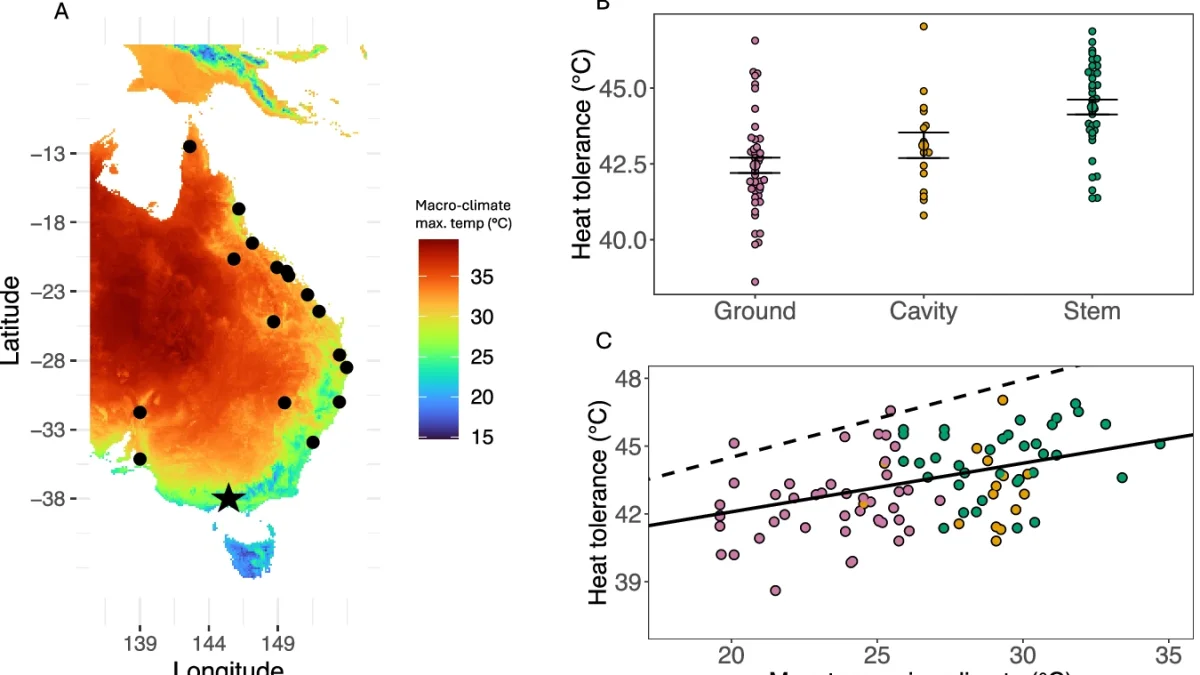
Phylogenetic models estimated distinct evolutionary optima for each nest type: stem nesters toward 44.9°C (112.8°F), cavity nesters 43.3°C (109.9°F), and ground nesters 42.9°C (109.2°F). Body size, measured via wing length, did not explain significant variation in heat tolerance — nor did latitude alone, with no support for Bergmann's rule across the sampled species.
Repeated evolution, not evolutionary deadlock
Heat tolerance showed moderate phylogenetic signal — closely related species tended to share similar tolerances — but much of that pattern dissolved once nesting behaviour and microclimate were accounted for. Statistical models favoured distinct thermal optima for each nest type evolving at the same rate, rather than a single constrained optimum for all bees.
A "wheatsheaf" analysis measuring repeated evolution found that species sharing the same nesting strategy had more similar heat tolerances than expected from phylogeny alone, especially among stem and ground nesters. The pattern points to repeated adaptive evolution of heat tolerance in response to nest microclimate, not a hard evolutionary ceiling on the trait.
Not just seasonal acclimation
One alternative explanation is phenotypic plasticity — that stem-nesting bees collected in summer simply acclimated to higher temperatures. To test this, the team sampled bees monthly through the active season (November–March) at Melbourne, the most seasonally variable site, assessing 542 individuals from 26 species.
Heat tolerance did not shift significantly across months for either ground or stem nesters. For ten species sampled in at least two months, species identity explained about 41% of variation in CTmax, while month explained only about 10%. Population-level comparisons across 43 species with multiple collection sites showed species differences far outweighed within-species geographic variation.
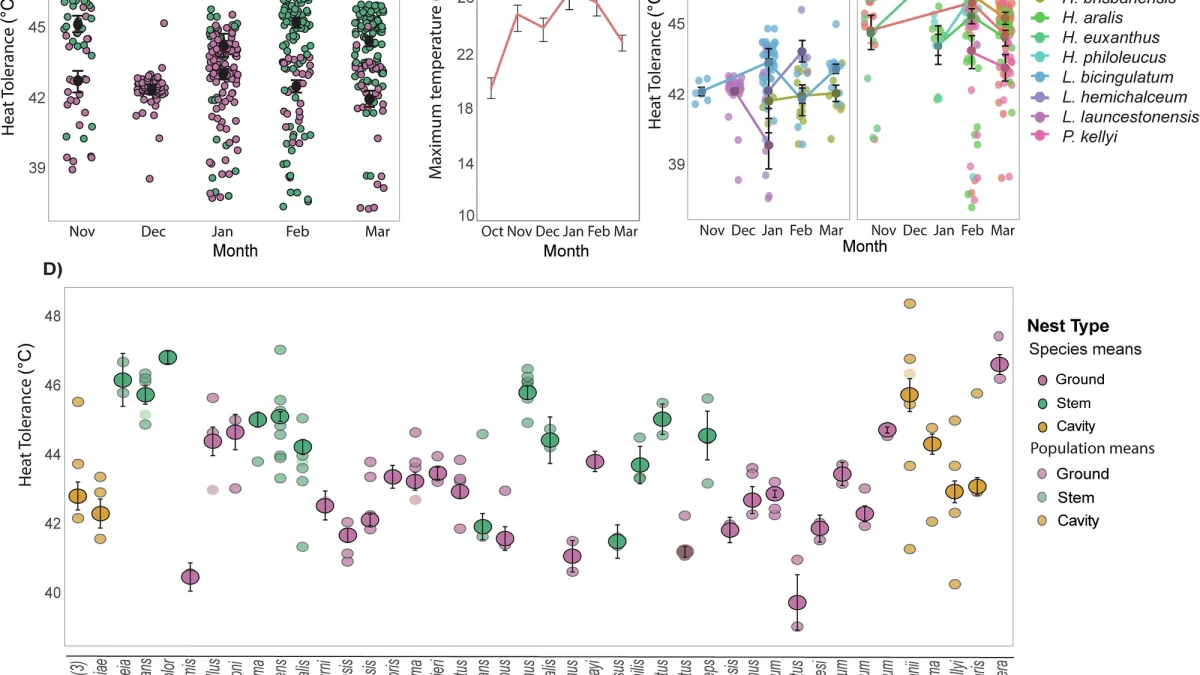
The findings suggest differences between nest types reflect evolved tolerances, not short-term acclimation — consistent with a growing literature showing limited plasticity in heat tolerance across ectotherms.
The vulnerability ranking flips
To identify which bees face the greatest near-term climate risk, researchers calculated thermal safety margins — the gap in degrees between a species' heat tolerance and the maximum temperature of its environment. Using air temperature alone, ground nesters appeared most vulnerable because they have the lowest CTmax values.
When nest microclimate temperatures were substituted, the ranking reversed completely. Stem and cavity nesters — despite their higher heat tolerances — occupied the hottest nests and therefore had the narrowest safety margins. At any given latitude, stem nesters were more vulnerable than sympatric ground nesters. Vulnerability also increased toward the tropics, where species already live closer to their thermal limits.
Dr da Silva told reporters that plant-stem nesters are the most heat tolerant because their homes offer the least protection — yet that same exposure makes them unable to retreat underground when heat spikes. Ground nesters, with lower tolerances but cooler refuges, are better buffered in the short term, though all bees must forage in the open air and will face rising exposure over longer timescales.
Conservation and food security
Tropical Queensland, home to many above-ground nesting species, still has one of the fastest land-clearing rates on Earth. Removing native forest eliminates the cooler microclimates that buffer sensitive pollinators in an already hot environment. Dr da Silva emphasised that conserving native vegetation and reducing greenhouse gas emissions are both essential to protect pollination services for native ecosystems and agriculture.
While the economic contribution of native bees is difficult to quantify precisely, stingless and solitary species play major roles pollinating tropical fruits and nuts including macadamias, lychees and watermelons. That role has grown in importance as Queensland's managed honeybee populations face pressure from the parasitic varroa mite. "It's really important that we have these native bees as backup pollinators," da Silva told InDaily.
The study confirms heat tolerance can evolve across generations in native bees, but whether adaptation can keep pace with the speed of anthropogenic warming remains an open question — and phenotypic plasticity appears unlikely to bridge the gap in the near term.
Track Australian temperatures on SatMeteo
As heat records climb across Australia's latitudinal gradient, from temperate Melbourne and Adelaide to tropical Brisbane and Cairns, monitoring local temperature patterns helps put pollinator stress in context. Check forecasts for your area and use the live temperature map on SatMeteo to follow heat building across the continent in real time.