




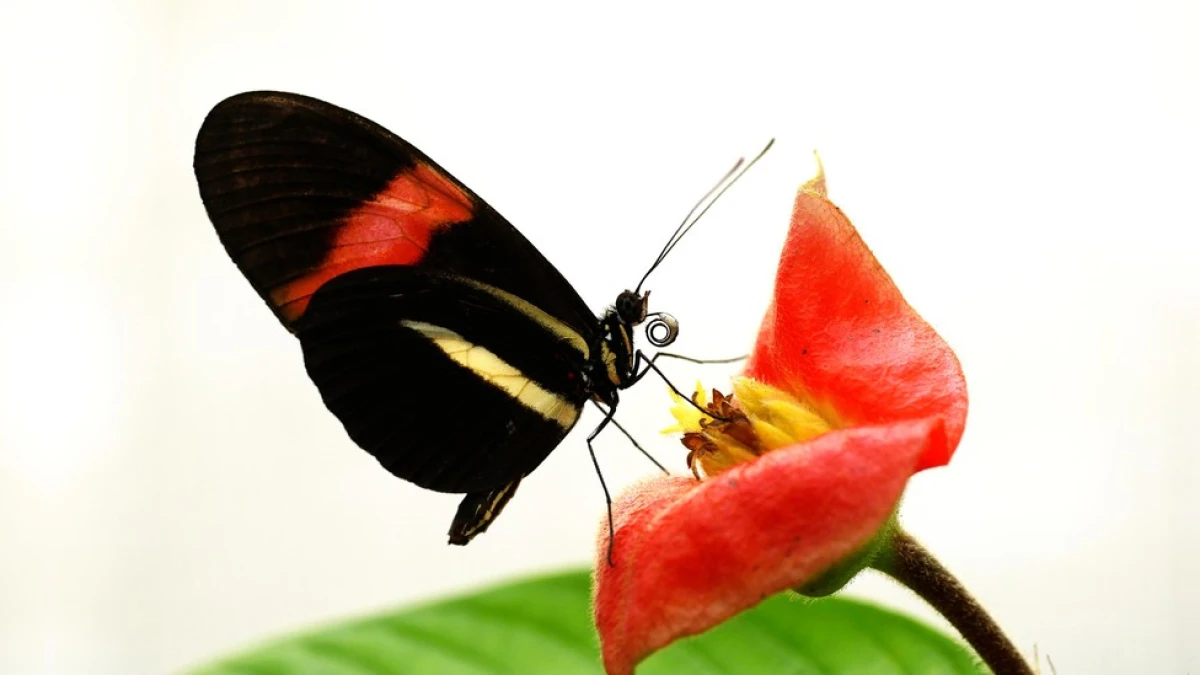
Most butterflies live only a few weeks as adults. A group of tropical species fluttering through the rainforests of Central and South America can survive for nearly a full year — and some appear to barely age at all. Research published 16 June 2026 in Nature Communications shows that Heliconius butterflies not only outlive their closest relatives by a wide margin, but have evolved a fundamentally different relationship with time, delaying the physiological decline that aging brings in ways that remain poorly understood.
Led by evolutionary biologist Jessica Foley of the University of Bristol's School of Biological Sciences, with colleagues at the Smithsonian Tropical Research Institute in Panama City, Panama, the team combined decades of field records, commercial butterfly-house data, and controlled insectary experiments to map how longevity and senescence vary across the Heliconiini tribe — a closely related group of Neotropical butterflies.
How the study worked
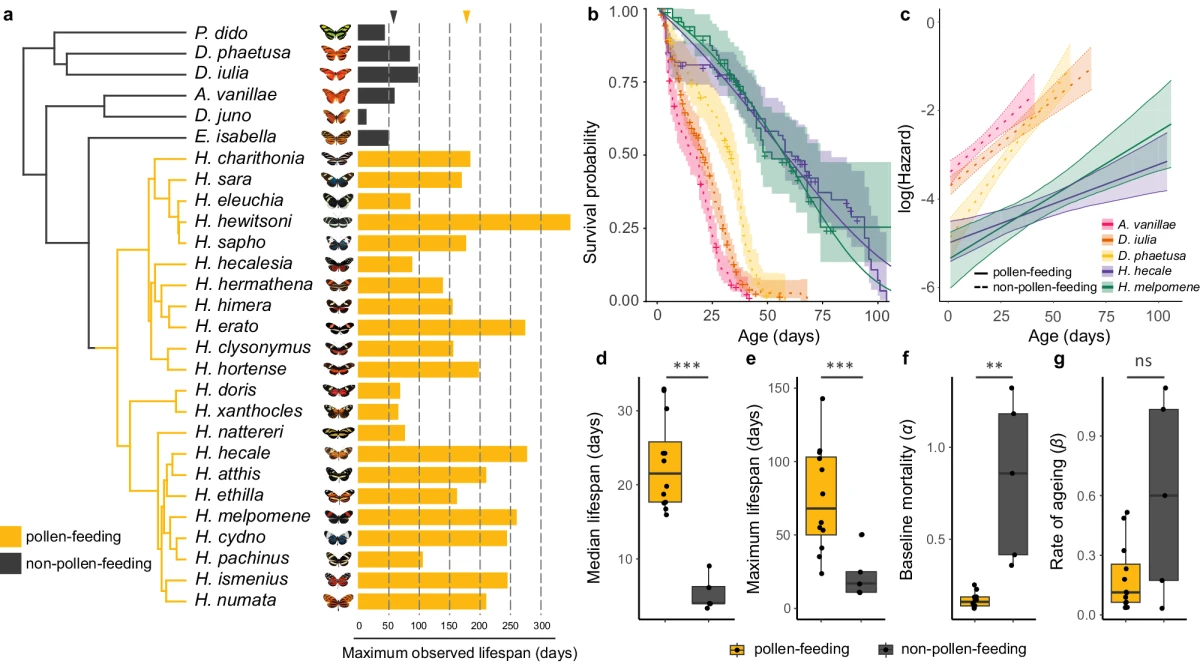
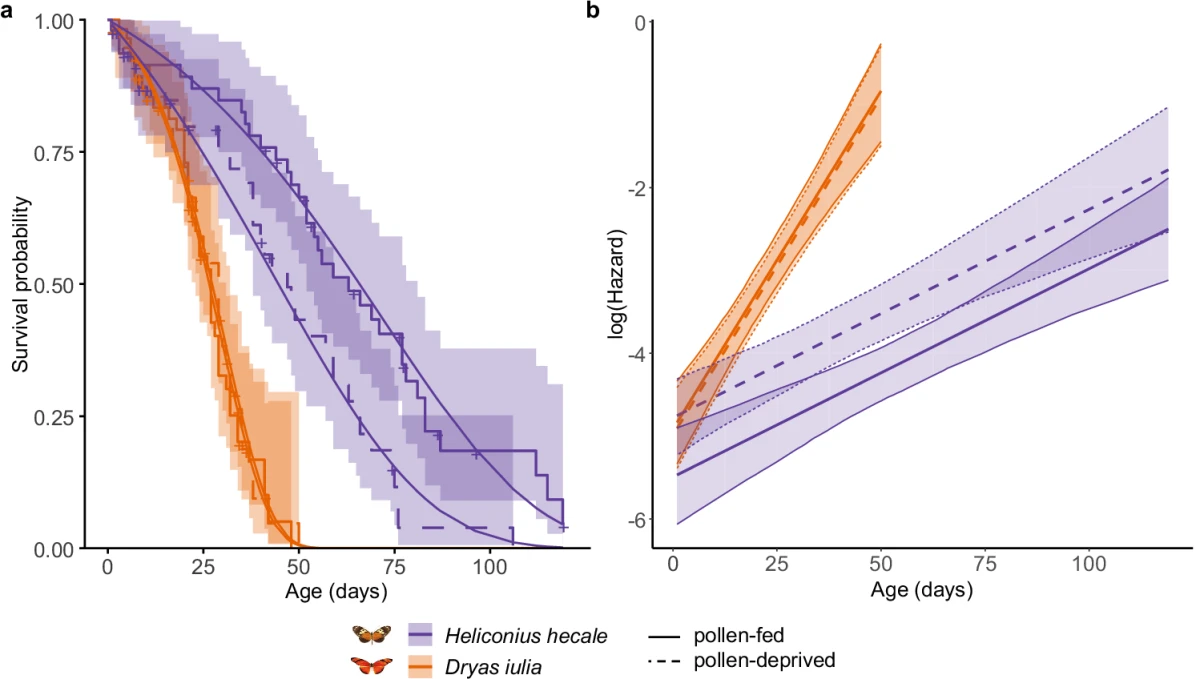
Researchers collated maximum reported lifespans from published mark-release-recapture studies, butterfly exhibitors, and captive populations, then analysed survival trajectories for 17 species using parametric models that separate baseline mortality from the rate of aging. In outdoor insectaries near Gamboa, Panama, they ran a pollen-manipulation experiment on two focal species — the long-lived pollen-feeding Heliconius hecale and the shorter-lived non-pollen-feeder Dryas iulia — tracking 212 butterflies from eclosion to natural death.
To measure functional senescence, the team weighed butterflies every two weeks and tested grip strength — how firmly each insect could hold a perch while being gently pulled upward — as a proxy for muscle function and whole-organism condition, an approach adapted from butterfly and beetle performance assays and used as a health biomarker in aging humans.
A 25-fold lifespan gap
The numbers are striking. Across the Heliconiini tribe, maximum reported lifespans ranged from 14 days in Dione juno to 348 days in Heliconius hewitsoni — a 25-fold difference between species that share a relatively recent common ancestor. Pollen-feeding Heliconius species averaged roughly 177 days at maximum lifespan, compared with about 58 days for non-pollen-feeding relatives. Median lifespans were also roughly three times longer in Heliconius, with lower baseline mortality and slower rates of actuarial aging.
"Heliconius butterflies are among the longest-lived butterflies, but what makes them particularly remarkable is that they appear to have evolved not only longer lifespans, but also slower ageing," Foley said in a university statement. "This allows them to live significantly longer than closely related species from which they diverged relatively recently in evolutionary time."
Among insects overall, maximum adult lifespans vary by roughly 5,000-fold — from mayflies that survive mere days to ant and termite reproductive castes that can live decades — far exceeding the roughly 100-fold range seen in mammals. That diversity makes insects a powerful natural laboratory for studying how lifespan is extended.
The pollen hypothesis
Most adult butterflies survive on nectar alone, which supplies energy but little protein. Heliconius species are the only butterflies known to actively collect and digest pollen as adults, extracting amino acids, lipids and other nutrients nectar cannot provide. The dietary shift is thought to support immune defences, energy storage and a lengthened reproductive lifespan in females.
The new study tested whether pollen directly extends life. In captive H. hecale, pollen access significantly improved survival: median lifespan was 63 days (maximum 119) with pollen versus 47 days (maximum 106) without it. In D. iulia, pollen made no difference — median survival stayed near 27–29 days regardless of diet, implying that Heliconius have evolved physiological adaptations to exploit pollen nutrition that their relatives lack.
Barely declining with age
One of the study's most surprising findings came from a simple physical test. Grip strength declined with age in D. iulia, with butterflies pulling an estimated 0.35 g less by week 5 than week 1 — a reduction of about 26%. In H. hecale, there was no detectable deterioration across a much longer lifespan, even into very advanced ages.
Pollen deprivation left H. hecale weaker overall — pulling roughly 12% less weight — but did not accelerate age-related grip loss. Both pollen-fed and pollen-deprived long-lived butterflies maintained functional performance in ways short-lived relatives could not.
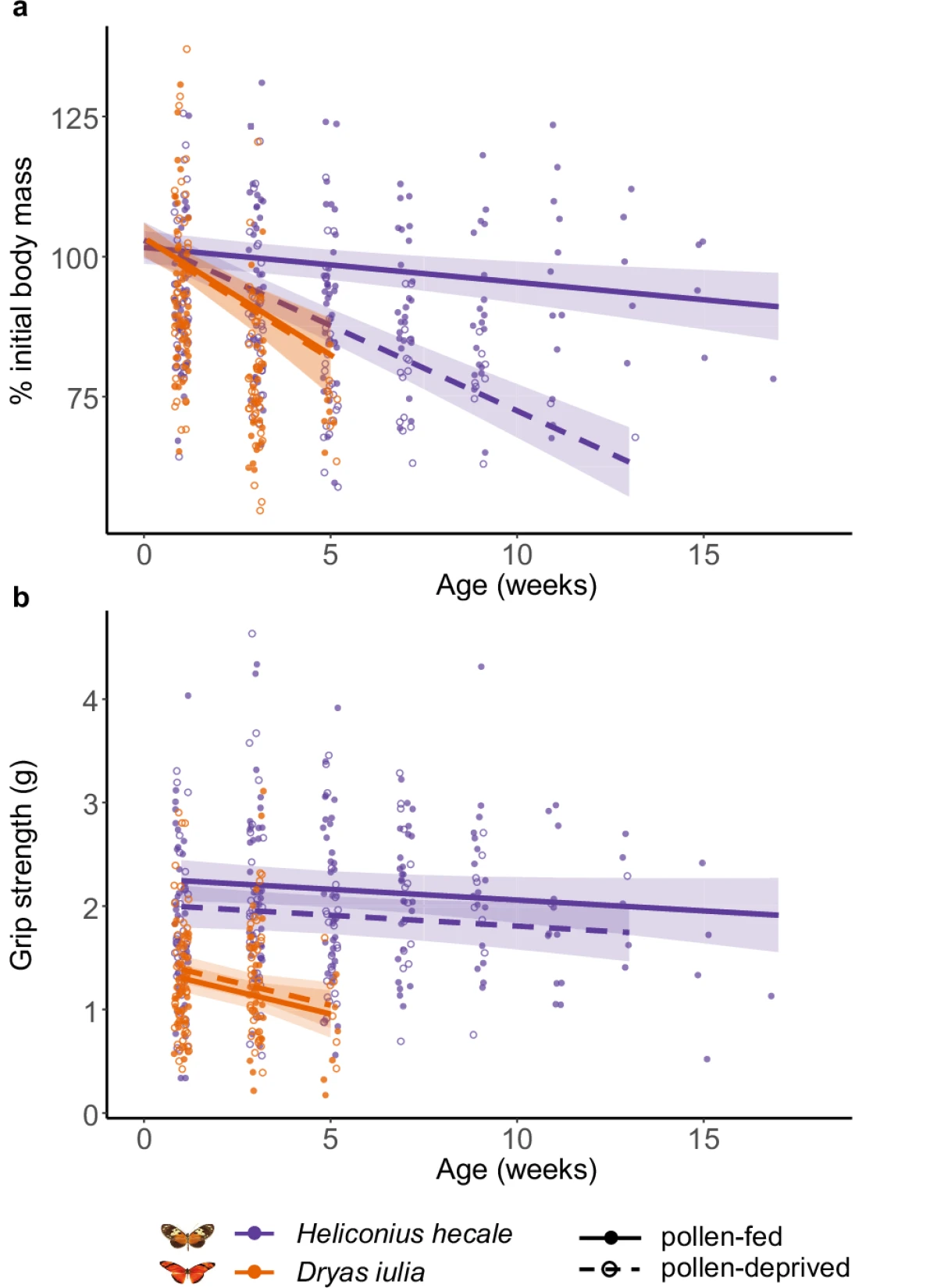
Body mass declined with age in both species, but pollen-deprived H. hecale lost mass faster than pollen-fed individuals — an estimated 3.50% per week versus 1.06% — while D. iulia lost about 6.50% per week regardless of diet.
Diet is not the whole story
Earlier work had suggested pollen deprivation might shrink Heliconius lifespans to match their short-lived cousins. This study found otherwise: even pollen-deprived H. hecale lived a median of 20 days longer than D. iulia, showing that part of the longevity advantage is inherited, not just nutritional.
The authors argue that when Heliconius evolved adult pollen feeding — roughly 18 million years ago — it loosened life-history constraints. Pollen supports continual egg production through adulthood, extending reproductive lifespan and exposing older ages to natural selection. Larval resources may also be reallocated toward somatic maintenance rather than reproduction at eclosion, helping even pollen-deprived individuals outlast relatives that depend solely on nectar and larval reserves.
Parametric survival analysis showed H. hecale has evolved a slower rate of aging than D. iulia — a difference that persists under pollen deprivation, pointing to genetic or epigenetic anti-aging mechanisms beyond short-term diet effects.
Why longevity research in insects matters
Mechanisms of aging are highly conserved across the animal kingdom. Studying long-lived lineages — from Greenland sharks to glass sponges — has repeatedly offered clues relevant to healthy aging in humans. Heliconius adds a new, experimentally tractable model: lifespans long enough to study senescence longitudinally, yet short enough for multi-year captive work, with a rich genomic toolkit and a recent evolutionary split from short-lived relatives.
"The exciting implication of this lifespan extension is that it provides a powerful opportunity to identify the mechanisms that underpin longevity," Foley said. "By comparing long-lived Heliconius butterflies with their short-lived relatives, we have a natural evolutionary experiment that can help reveal how lifespan is extended."
From the cloud forests of Panama to the Andean foothills near Bogotá, these postman butterflies and their kin patrol flowering plants year-round in some of the planet's most biodiverse habitats. How they slow time while their relatives fade in weeks may eventually help researchers decode constraints on aging that apply far beyond the rainforest canopy.