

Southern Europe is set to be the standout tourism region of summer 2026. New analysis from The Data Appeal Company / Almaviva Group, published on 11 June and reported widely across travel media, shows Greece, Spain and Italy recording the strongest growth in international travel demand as holidaymakers increasingly choose destinations that feel closer, more familiar and more accessible amid geopolitical tension, flight rerouting and higher airline operating costs.
For travellers, that shift is not only about booking convenience — it is also a bet on predictable sunshine. Mediterranean summers bring long daylight, reliable beach weather and city-break warmth, but they also carry rising heat, wildfire risk in parts of the south and crowded peak-season afternoons. Understanding what June through August typically delivers — and how 2026 may differ — helps turn a trending destination into a trip that actually works on the ground.
What the travel data shows
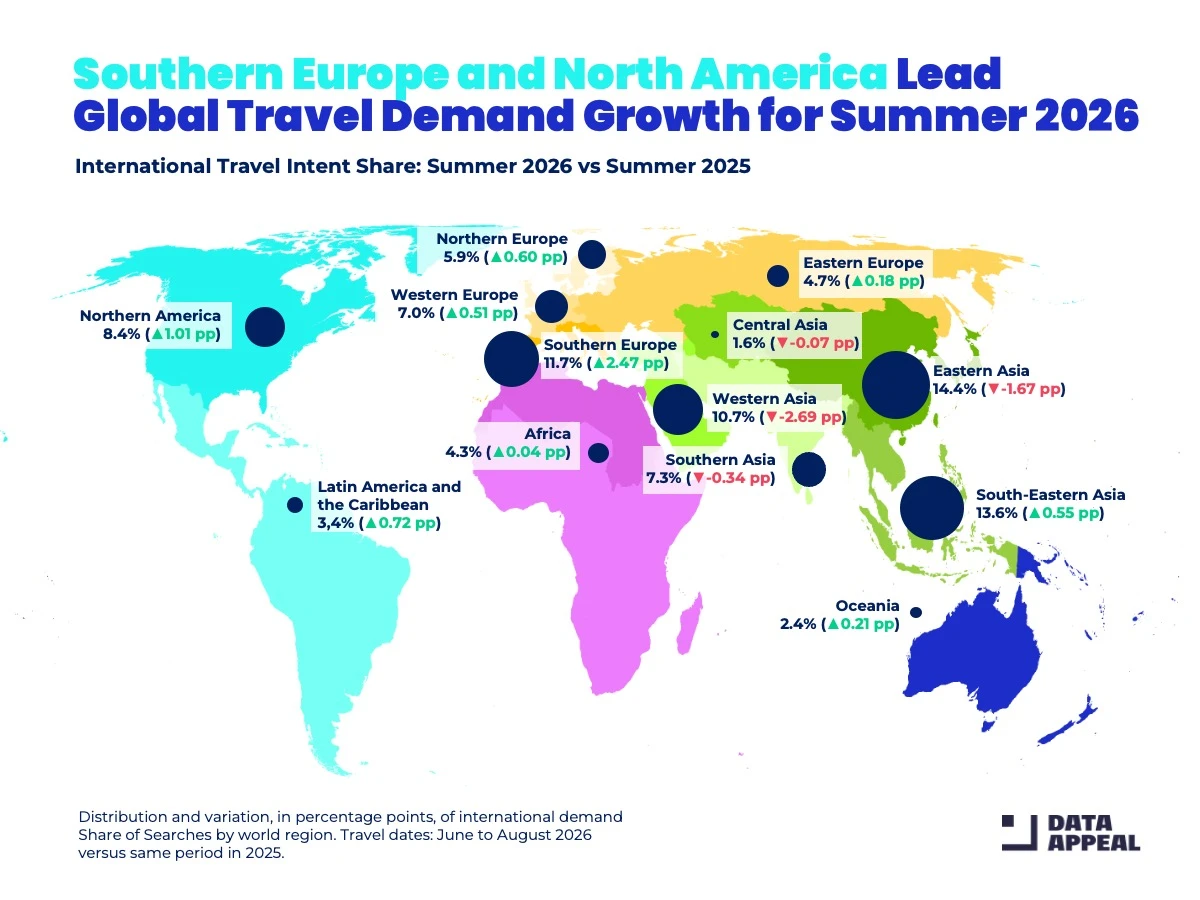
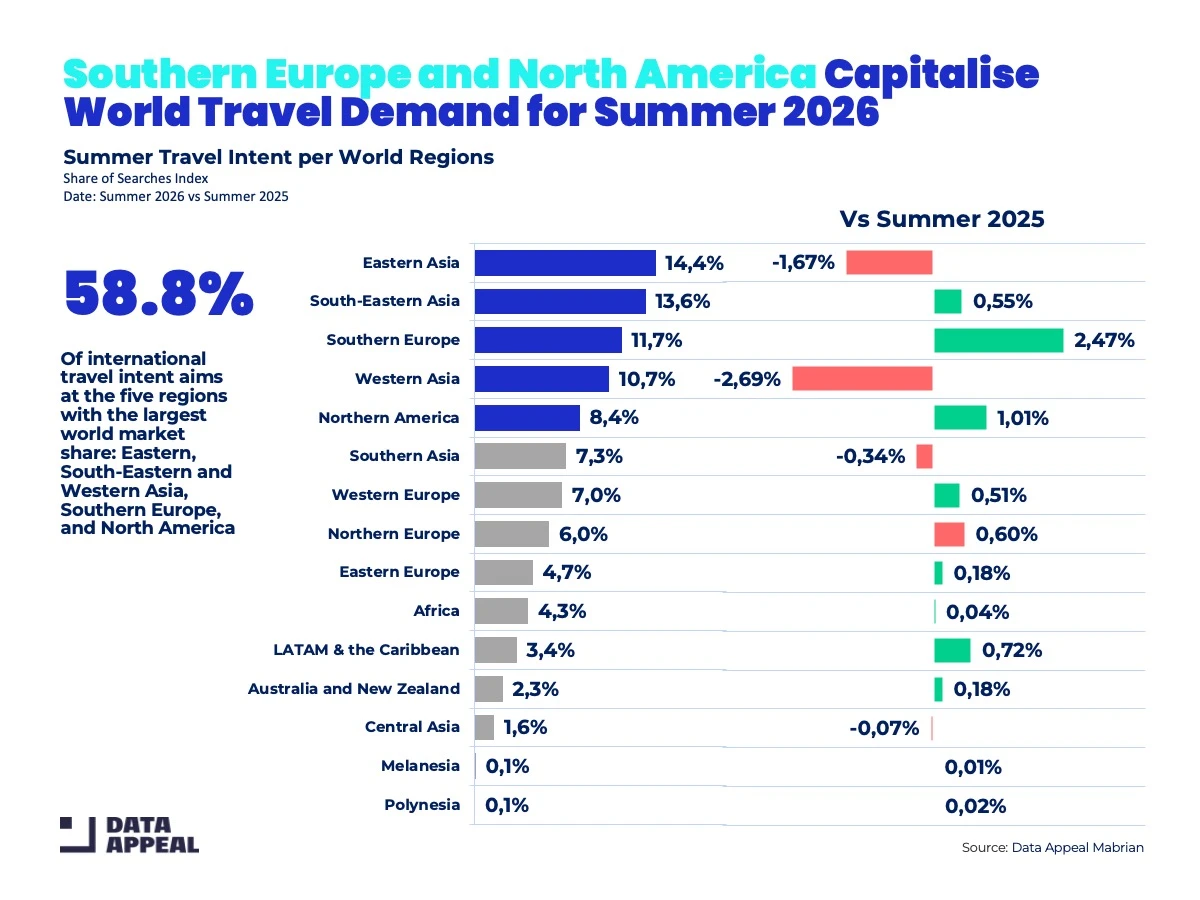
The findings are based on Data Appeal Mabrian's Share of Searches Index, a proprietary measure of global flight-search behaviour for June, July and August 2026 compared with the same period in 2025. Between those months, Southern Europe is projected to capture 11.71% of global international travel intent — an increase of +2.47 percentage points year-on-year, the largest regional gain in the Northern Hemisphere summer season.
Among Southern European cities, the ranking by global search share tells a clear story:
- Barcelona — 1.01% of global intent (+0.22 pp YoY), the region's most searched city
- Madrid — 0.91% (+0.14 pp)
- Rome — 0.85% (+0.09 pp)
- Athens — 0.77% (+0.23 pp), the largest city-level increase in the region
- Milan — 0.76% (+0.10 pp)
Athens benefits from its dual appeal as a city-break destination and a gateway to the Greek islands. Barcelona, Madrid, Rome and Milan strengthen Spain and Italy's position through strong air connectivity and the enduring popularity of Mediterranean beach holidays.
Carlos Cendra, Chief Marketing and Communications Officer at Data Appeal, said summer travel intent suggests that as air connectivity and flight corridors are disrupted, "long-haul demand is naturally reorganising towards destinations that feel closer, more familiar and more accessible." Data Appeal Mabrian had flagged a similar redistribution toward Southern Mediterranean destinations in the weeks after disruptions linked to the Iran conflict began affecting Middle Eastern air corridors.
Why travellers are pivoting south
Several forces are converging this summer:
- Geopolitical uncertainty: Western Asia recorded the steepest regional decline in the dataset, losing 2.69 percentage points of global market share. Tensions affecting Middle Eastern airspace have prompted rerouting, higher fuel costs and longer journeys — pushing many European and North American travellers toward short- and medium-haul Mediterranean options.
- Connectivity and familiarity: Greece, Spain and Italy combine dense flight networks, well-developed tourism infrastructure and a cultural familiarity that reduces planning friction for first-time and repeat visitors alike.
- Event spillover: While the FIFA World Cup 2026 is lifting North American gateway cities, many European travellers are staying within the continent for summer holidays rather than crossing the Atlantic.
- Value perception: Despite rising accommodation costs in hotspots, Southern Europe still offers a competitive package of climate, cuisine and coast compared with some premium long-haul alternatives whose prices have climbed with detour routes.
Weather outlook: what June–August brings
Seasonal forecasts for summer 2026 point to above-average temperatures across much of Europe, with the strongest heat signals over southeastern areas — precisely where travel demand is rising fastest. After record-breaking warmth in late spring, experts warn of compound heat-and-drought conditions in southern Europe and elevated wildfire risk along an arc from Portugal to Greece. That does not cancel a Mediterranean holiday, but it does shape when and how to travel.
Athens and the Greek islands
Athens sits in a hot-summer Mediterranean climate. June through August typically brings daytime highs of 30–34°C (86–93°F), very low rainfall and strong sunshine — ideal for island ferries and evening dining in the Plaka, but punishing for midday Acropolis climbs without shade and water. Sea breezes moderate coastal areas; inland Attica can feel several degrees hotter. Best strategy: sightsee early, swim in the afternoon, expect warm nights above 22°C (72°F) in July and August.
Barcelona and the Catalan coast
Barcelona combines beach weather with urban culture. June averages highs near 26°C (79°F) with only a handful of rainy days; July and August push into the high 20s and low 30s °C (mid-80s to low 90s °F). Afternoon sea breezes can shave 1–2°C (2–4°F) off coastal readings while inland Vallès towns run hotter. August crowds peak along the Costa Brava; May–June and September offer lighter humidity and easier sightseeing.
Madrid and inland Spain
Inland Madrid runs hotter and drier than Spain's coasts. Summer afternoons commonly reach 33–36°C (91–97°F), with heat spikes above 38°C (100°F) during Saharan air intrusions. The city's altitude near 650 metres (2,130 ft) moderates nights slightly, but open plazas and museum queues still demand morning starts and siesta-aware scheduling. Retiro Park and rooftop bars come alive after sunset; air conditioning is not optional for many travellers in July.
Rome and Milan
Rome and Milan anchor Italy's summer surge. Rome's historic centre traps heat — expect 30–33°C (86–91°F) in June and often higher in July and August — while fountains and gelato stops become part of any sensible itinerary. Milan, nearer the Po Valley, shares hot summers but can feel more humid; evening aperitivo culture fits the long twilight. Both cities see brief thunderstorms in late summer, but June–August rainfall totals remain modest compared with northern Europe.
The coolcation counter-trend
Not every traveller wants Mediterranean heat. Northern Europe captured 5.96% of global travel intent this summer, gaining +0.60 percentage points year-on-year and benefiting from the "coolcation" trend — holidays built around milder temperatures. London, Edinburgh, Dublin and Copenhagen attract visitors seeking comfortable walking weather, long summer evenings and alternatives to southern heatwaves. Iceland and Scotland's Highlands extend that logic with dramatic scenery and daytime highs that rarely exceed the mid-teens to low 20s °C (around 60–70°F).
If your priority is outdoor activity without 35°C (95°F) afternoons, northern capitals reward June through August with festivals, daylight past 21:00 and lower wildfire or heat-stress risk — at the cost of occasional rain and cooler sea temperatures for swimming.
North America and Asia in the same dataset
The same analysis highlights broader redistribution of summer demand. North America accounts for 8.36% of global travel intent, up +1.01 percentage points year-on-year, with World Cup gateway cities including New York, Los Angeles and Miami benefiting from international interest; Vancouver (0.60%, +0.11 pp) and Calgary (0.35%, +0.09 pp) lead growth among Canadian destinations.
Asia still dominates overall — Eastern Asia (14.41%, −1.67 pp) and South-Eastern Asia (13.58%, +0.55 pp) together draw more than one in four international travellers. Western Asia retains 10.71% of global intent despite its steep decline. South-Eastern Asia's bright spots include Bali (1.38%, +0.32 pp), Manila (1.12%, +0.16 pp) and Jakarta (0.77%, +0.11 pp). Latin America and the Caribbean gained +0.72 percentage points, among the strongest regional increases globally, led by Peru, Brazil and Mexico.
How to plan a Southern Europe trip in 2026
- Book heat into your schedule: For Athens, Rome and Madrid, plan outdoor sightseeing before 11:00 or after 18:00; reserve midday for museums, lunch or pool time.
- Compare coast and inland: Barcelona and the Greek islands cool more at night than Madrid or inland Italy — useful if you struggle with warm sleeping conditions.
- Watch wildfire and air-quality alerts: During heatwaves, southern regions can issue fire-weather warnings; check local civil-protection apps if you are renting a car or hiking in forested areas.
- Consider shoulder season: Late May, early June and September often deliver the same sunshine with thinner crowds and slightly lower prices than peak July–August.
- Balance with coolcation: A two-centre trip — Edinburgh or Copenhagen first, Barcelona or Athens second — combines mild northern days with guaranteed southern warmth.
Check conditions before you fly
Flight-search trends tell you where the world wants to go; forecasts tell you what to pack. Compare live outlooks for Athens, Barcelona, Madrid, Rome and Milan on SatMeteo, and use the live temperature map to see how heat is building across the Mediterranean basin before you lock in dates and accommodation.