




Airport architecture rarely makes headlines outside trade magazines. On 15 June 2026, it did. The Prix Versailles named seven newly opened terminals to its World's Most Beautiful Airports list — buildings across China, Germany, India, Cambodia and the United States that secretary general Jérôme Gouadain described as innovative landmarks of their regions and their eras.
The selection is not a popularity contest. Three of the seven will receive further World Titles in December — for overall design, interior excellence or exterior architecture — after a year in which the organisation has already shortlisted restaurants, hotels and museums. For travellers, the list matters for a simpler reason: these are the terminals you will increasingly walk through on the way to a city break, a monsoon connection or a transcontinental hub change. What they look like — and what the weather does outside — shapes how the trip feels from the moment you land.
What the Prix Versailles actually recognises
Since 2015, the Prix Versailles has announced annual selections at UNESCO, honouring contemporary architecture and design across airports, campuses, museums, hotels, restaurants and passenger stations. Its stated criteria weigh innovation, creativity, local heritage, ecological efficiency and social interaction — projects judged partly on ecological, social and cultural impact, not only on visual appeal.
What the programme does not publish in detail is its full jury roster or a transparent scoring methodology. Selection is not an open public vote, and firms do not apply through a single visible open call in the way some design competitions operate. That opacity is worth keeping in mind when reading any "most beautiful" shortlist — including this one. Even so, the 2026 airport lineup aligns with a real wave of terminal openings between 2025 and early 2026, when capacity, passenger experience and regional identity have become as critical as runway length.
The seven terminals on the 2026 list
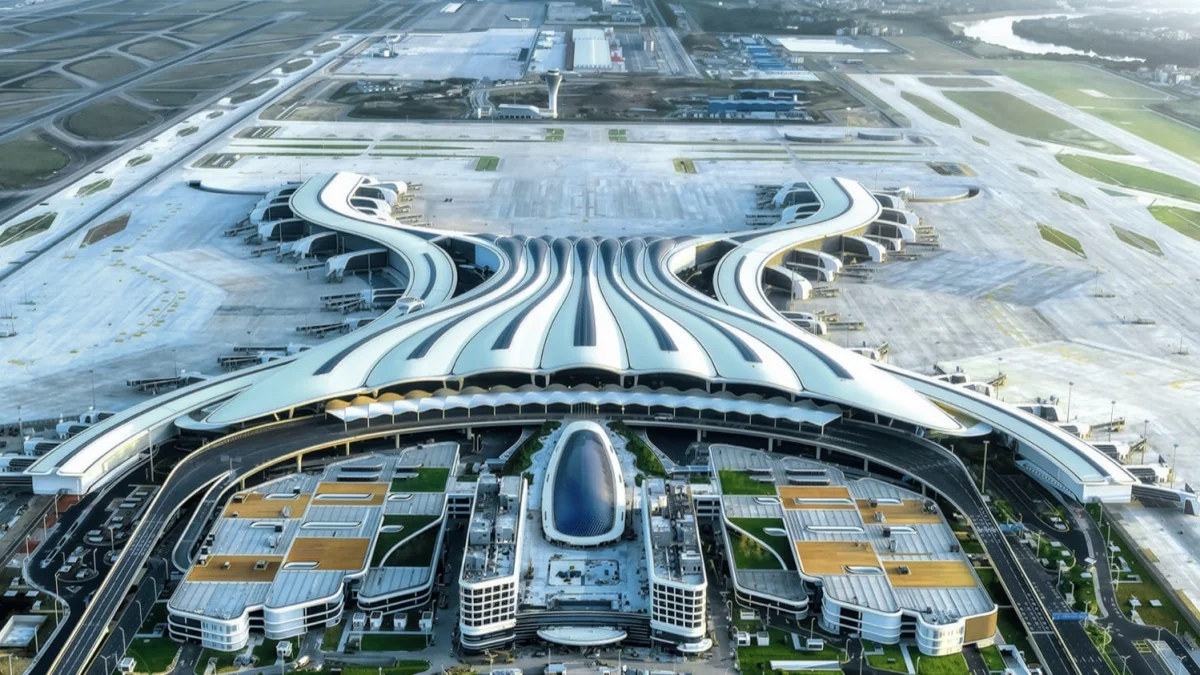
Guangzhou Baiyun International Airport, Terminal 3 — Artelia and GDAD
Terminal 3 at Guangzhou's main hub takes its formal language from the clouds, water and flowers of China's Lingnan region. Artelia and the Guangdong Architectural Design and Research Institute organised the building as a sequence of terraces, atriums and gardens rather than a single cavernous box — light-filled curves meant to guide passengers intuitively while evoking Maritime Silk Road prosperity. The project team also claims the highest open-air public observation deck at any Chinese airport, turning a transfer stop into a deliberate hospitality gesture for Greater Bay travellers and China Southern Airlines passengers alike.
Frankfurt Airport, Terminal 3 — Christoph Mäckler
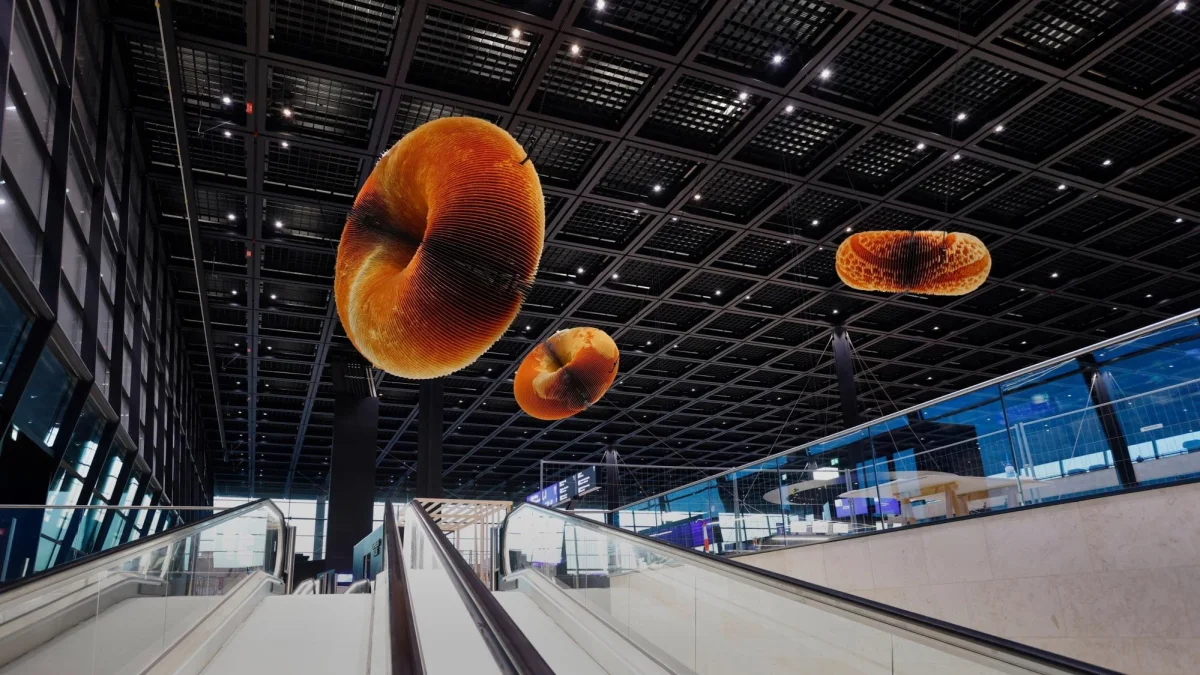
Frankfurt is the only European hub on the list — and among the most consequential openings of 2026. Fraport inaugurated Terminal 3 on 22 April; passenger operations began the following day. Christoph Mäckler's design occupies roughly 1.3 square kilometres (0.5 square miles), about the footprint of Frankfurt's historic centre, and is built to handle 19 million passengers annually, rising to 25 million at full development.
Inside, piers, gates and lounges are proportioned like city streets and squares, lined with Jura limestone and travertine and lit through large plate-glass facades. Three suspended ring sculptures of coloured aluminium discs rotate above the concourse, constantly shifting how passengers read the space — sociability and engineering presented as a single experience. For Lufthansa's home hub, this is the largest infrastructure project in Fraport's history and the building that will increasingly define Frankfurt connections.
Lokapriya Gopinath Bardoloi International Airport, Terminal 2 — Nuru Karim
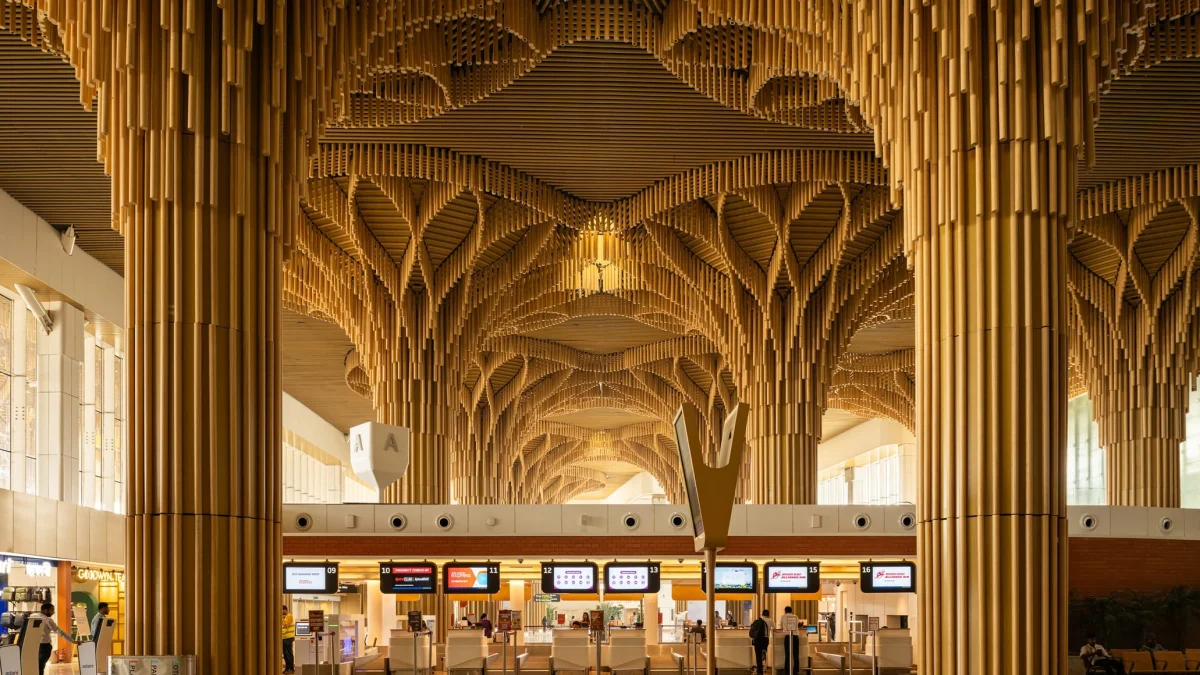
In Guwahati, architect Nuru Karim looked to Assam's sacred landscapes and indigenous building traditions rather than the generic international style. Sweeping vaulted ceilings reference the bamboo orchid; ceiling patterns trace the Brahmaputra River and its tributaries, guiding passengers through open, legible spaces without reliance on signage alone. Tribal art and local craftsmanship are built into waiting areas and transition zones — turning dead time into moments of regional discovery for a terminal that serves as the aviation gateway to Northeast India's Seven Sister states.
Navi Mumbai International Airport, Terminal 1 — Zaha Hadid Architects
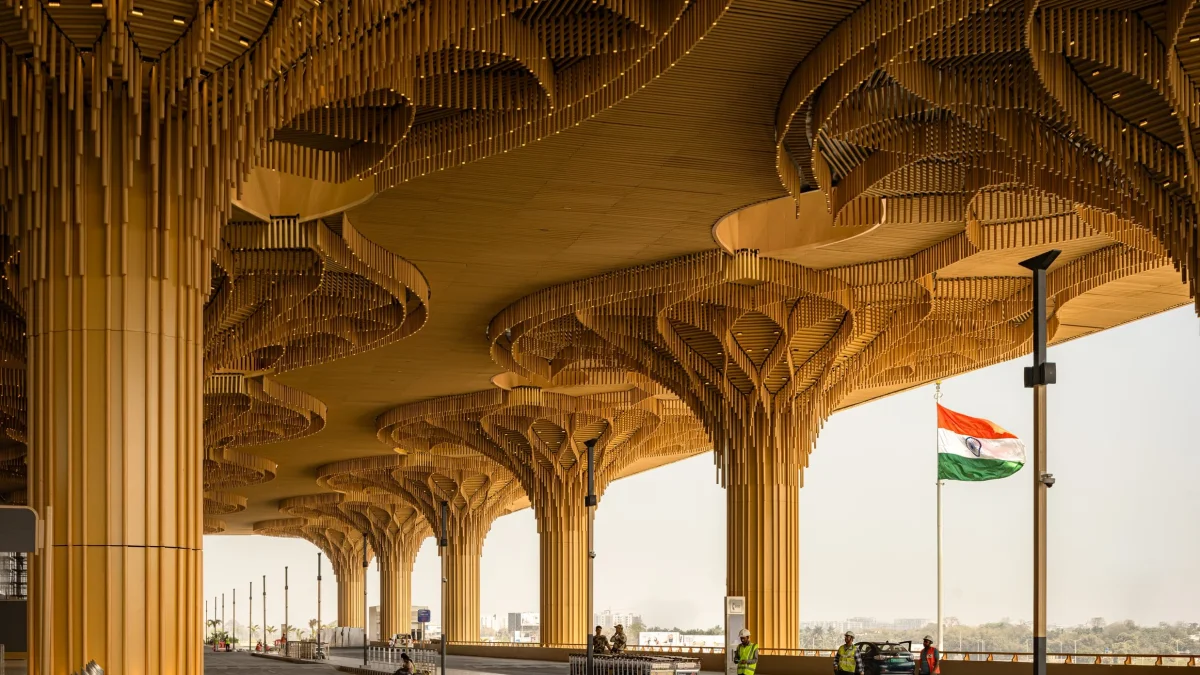
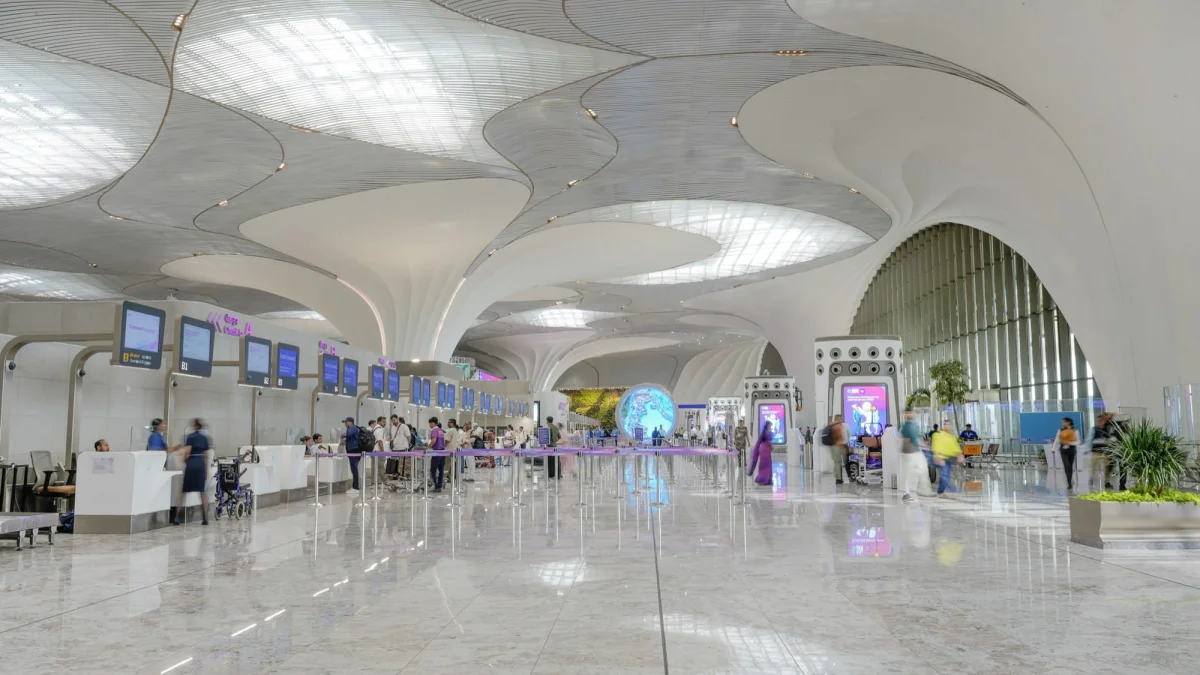
Mumbai's long struggle with a single overcrowded international airport is easing. Prime Minister Narendra Modi inaugurated Navi Mumbai International Airport Phase 1 on 8 October 2025; commercial flights began on 25 December. Zaha Hadid Architects shaped Terminal 1 around India's national flower: lotus-inspired roof overhangs, geometric arrival portals and signature columns that flare like unfurling petals in morning light.
Built on reclaimed marshland after major civil-engineering works, NMIA is designed to operate alongside Chhatrapati Shivaji Maharaj International Airport, eventually scaling toward 90 million passengers per year. A curated digital art programme at key pause points reinforces the sense that Mumbai's second gateway is meant to be a cultural landmark, not merely a congestion valve.
Techo International Airport — Foster + Partners
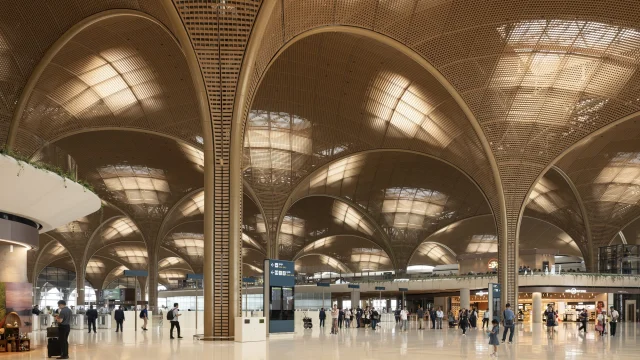
Cambodia's new capital gateway opened to commercial traffic in September 2025 and was officially inaugurated on 20 October, replacing the ageing Phnom Penh International Airport. Foster + Partners placed the terminal beneath a single undulating roof that rises to a central crescendo echoing Khmer temple silhouettes. Interior ceilings mimic traditional basket weaving in bamboo and rattan, filtering daylight and reducing reliance on mechanical ventilation and artificial lighting during the day.
Native rumduol trees — Cambodia's national flower — rise in the central void, and the layout prioritises short walks from kerbside to gate. Located about 20 km (12 miles) south of Phnom Penh, Techo is designed for tropical comfort as much as capacity, with an onsite solar farm supporting much of the terminal's power needs.
Pittsburgh International Airport — Gensler, HDR and luis vidal + architects
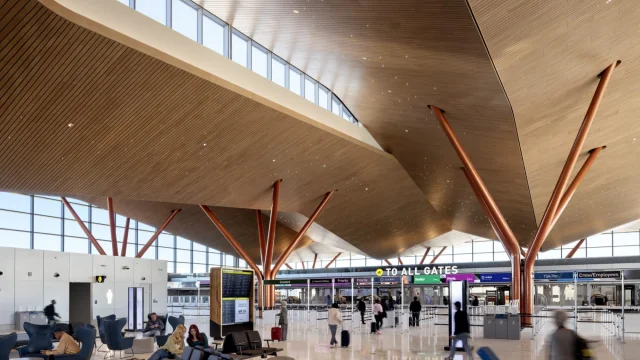
Pittsburgh's new landside terminal replaces a building that opened in 1992. Gensler and HDR, with luis vidal + architects, drew a rolling roofline from the nearby Allegheny Mountains and installed 38 steel columns sculpted like trees beneath a faceted wood-lined canopy. Glass walls flood the hall with daylight; outdoor terraces offer fresh air, and a Petal Tunnel nods to the city's Fort Pitt Tunnel.
The project is also pitched as a model for shorter passenger distances, inclusive comfort features and improved energy performance — a biophilic counterpoint to the industrial heritage of Pittsburgh and a reminder that American airport design is increasingly looking inward to local landscape rather than outward to a global template.
San Diego International Airport, Terminal 1 — Gensler and James Carpenter
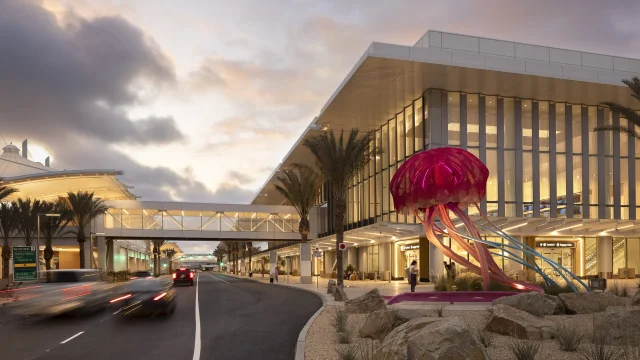
San Diego's Terminal 1 replaces the structure that served America's busiest single-runway airport for decades. Gensler choreographed a continuous procession from kerb to gate, centred on a 244-metre (800-foot) curved glass façade developed with artist-architect James Carpenter — filtering daylight while tempering heat and glare in a climate where sun and bay views are part of daily life.
Removing structural columns from the ticketing hall opened the space and, according to the design team, cut the building's carbon footprint by roughly 30%. Outdoor terraces overlook the bay; local concessions and flexible lounges reinforce the city's outdoor culture. A luminous jellyfish sculpture marks the kerbside approach — playful public art in a building that otherwise takes its cues from San Diego's waterfront promenades and gardens.
Three World Titles still to come
The June shortlist is not the final word. In December 2026, Prix Versailles will award three of the seven airports additional World Titles — for overall design, interior excellence or exterior architecture. That staggered process is typical across the programme's categories and gives jurors time to evaluate how buildings perform once daily passenger traffic, not press tours, defines the experience.
Weather at each gateway city
Striking architecture sets the first impression; climate determines what to pack and when to move. Here is what travellers typically encounter at each gateway through the year.
Guangzhou
Guangzhou sits in a humid subtropical zone. Summers from June through September bring daytime highs near 32–34°C (90–93°F), high humidity and frequent afternoon thunderstorms. Winters are mild, with lows rarely below 10°C (50°F). Best months: October to December for lower humidity; avoid peak summer if heat stress is a concern.
Frankfurt
Frankfurt has a temperate oceanic climate. Summer highs average 24–26°C (75–79°F) in July; rain is possible year-round. Winters are cool, often 2–5°C (36–41°F) in January with occasional snow. Best months: May to September for outdoor city walks; pack a light rain layer regardless of season.
Guwahati
Guwahati is a monsoon gateway. Pre-monsoon April and May can push highs above 35°C (95°F) with building humidity. The southwest monsoon from June to September delivers heavy rainfall — monthly totals often exceed 300 mm (12 inches). Best months: November to February for wildlife and tea-country travel.
Mumbai and Navi Mumbai
The Mumbai region is tropical coastal. The southwest monsoon from June to September brings intense rain and humidity; pre-monsoon May is often the hottest month. The dry season from November to February offers the most pleasant conditions — daytime highs around 30°C (86°F) with lower humidity and sea breezes. Best months: November to February; plan indoor buffer time during monsoon weeks.
Phnom Penh
Phnom Penh has a tropical wet-dry rhythm. The dry season from November to February is the most comfortable, with highs near 31°C (88°F). April and May are the hottest months before the southwest monsoon, often exceeding 35°C (95°F). Best months: November to January for Angkor side trips and city exploration.
Pittsburgh
Pittsburgh experiences four distinct seasons. Summers are warm and humid, with July highs near 28°C (82°F). Winters are cold and snowy — January lows often near −5°C (23°F) — and lake-effect systems can disrupt connections. Best months: September and October for foliage and comfortable walking weather; build extra connection time during winter snow events.
San Diego
San Diego is famously mild. Coastal highs average 22–26°C (72–79°F) in summer, with June gloom — a morning marine layer — often burning off by afternoon. Rainfall concentrates in winter; summers are dry and sunny. Best months: year-round for outdoor culture; May and October offer warmth without peak crowds.
Plan around the terminal — and the forecast
The Prix Versailles list celebrates buildings that treat arrival as part of the journey. Whether you connect through Frankfurt's limestone concourses, walk beneath Techo's basket-weave ceiling or step into San Diego's glass-walled hall, the weather waiting outside still determines what to pack and when to move.
Check live forecasts for Guangzhou, Frankfurt, Guwahati, Mumbai, Phnom Penh, Pittsburgh and San Diego on SatMeteo, and use the live temperature map to compare conditions across your route before you book connections or ground transport.