




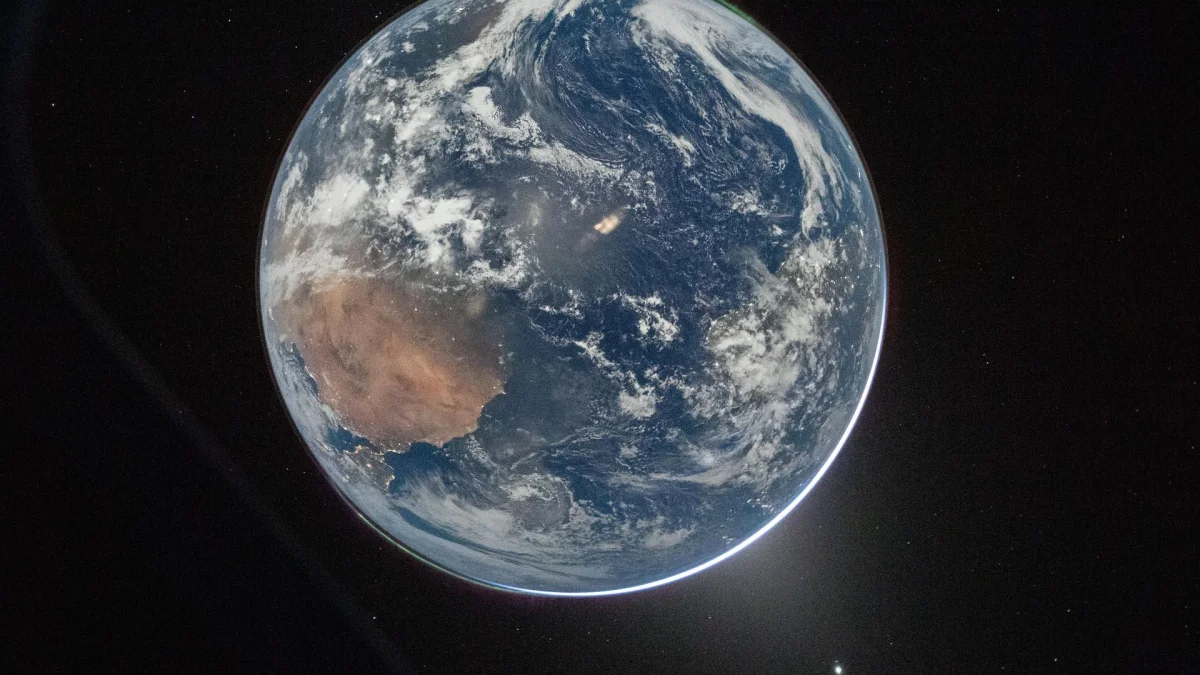
On 2 April 2026, Artemis II Commander Reid Wiseman aimed a camera back at Earth from the Orion spacecraft just after translunar injection. The result is not a standard sunlit "Blue Marble." It is a moonlit portrait of Earth's nightside — and in a single frame, green auroral bands glow at both the northern and southern poles at once. When Live Science highlighted the image in mid-June as its space photo of the week, the detail many viewers missed on a phone screen was exactly that: a rare double aurora on the dark side of our planet.
Earth's dark side, lit by the Moon
From Orion's vantage point, the Sun sat directly behind Earth, eclipsed by the planet. The hemisphere facing the camera was in nighttime. What looks like daylight in the photograph is actually moonlight — sunlight reflected off the 1 April 2026 full Moon (the Pink Moon) and bounced back toward space.
Wiseman captured the shot with a Nikon D5 at ¼ second, f/4, ISO 51,200 — extreme sensitivity needed to reveal faint features on an unlit hemisphere. Stars visible in the background confirm this is Earth's nightside; on a sunlit dayside exposure, they would be washed out entirely. A thin bright crescent at the lower right is not the lunar surface but sunlight filtering through Earth's atmosphere at the limb.
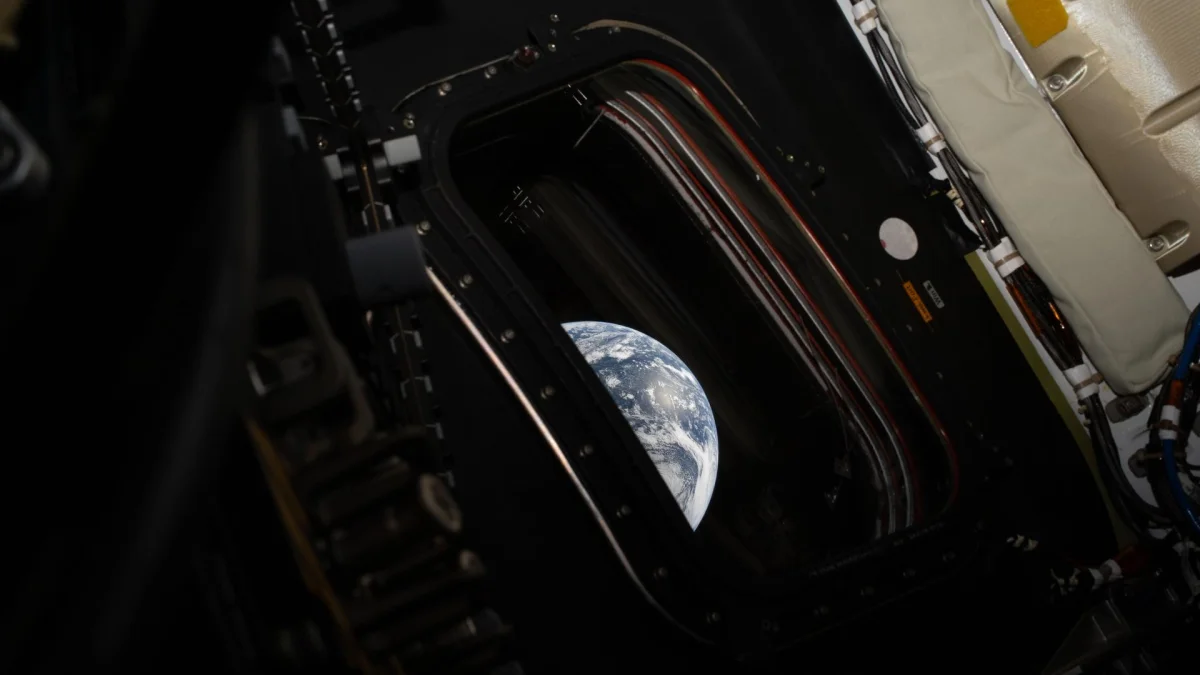
City lights trace human habitation across the moonlit disk: the Iberian Peninsula and northern Africa to the left, sub-Saharan Africa at centre, and coastal Brazil to the right. Without the full Moon's reflected glow and the camera's high ISO, those lights — and the auroras — would be far harder to capture in one human-taken frame from deep space.
The rare double aurora
Look closely at the top and bottom of Earth's disk and you will see two bands of green light — the aurora borealis (northern lights) and the aurora australis (southern lights) shining together. NASA's Earth Observatory identifies the northern oval toward the lower left of the frame and the southern oval toward the upper right. Both are driven by the same process: charged particles from the solar wind travelling along Earth's magnetic field lines and colliding with oxygen and nitrogen in the upper atmosphere, typically 100–300 km (62–186 miles) above the surface.
Auroras are common in photographs from the International Space Station, but the ISS orbits at roughly 400 km (250 miles) with an inclination of 51.5° — astronauts skim one auroral oval at a time and cannot see a wide enough slice of the planet to capture both poles in a single photograph. Wiseman's view from roughly 8,500 km (5,300 miles) above Earth's surface, on a trajectory beyond low Earth orbit, provided the geometry needed to frame both ovals at once.
That makes this image distinctive: a single crew-taken photograph showing self-luminous auroras against a moonlit nightside — not an automated ultraviolet composite from a scientific satellite, and not a low-orbit view limited to one hemisphere.
Conjugate auroras — mirror lights, imperfect twins
Auroras at opposite poles are conjugate — linked by shared geomagnetic field lines that connect the northern and southern hemispheres. Scientists have suspected mirror-image behaviour for centuries. When Captain James Cook recorded a southern aurora from the HMS Endeavour on 16 September 1770, historical documents from northern China describe auroral lights on the same night — early evidence that both hemispheres can light up together.
Definitive proof required space-based global imaging. On 22 October 2001, during a geomagnetic storm, NASA's Polar spacecraft captured the first clear simultaneous view of both auroral ovals with enough resolution to study their dynamics. Dr Nicola Fox, then the spacecraft's operations manager, called it the first time both ovals had been seen simultaneously with such clarity.
Later missions — notably IMAGE and Polar working in tandem — revealed that conjugate auroras are not perfect mirror images. Asymmetries appear depending on solar-wind conditions, the tilt of Earth's magnetic field, and the orientation of the interplanetary magnetic field. The ovals can shift, brighten, and dim in related but not identical ways. Artemis II's visible-light portrait does not replace that satellite science, but it makes the conjugate-aurora story tangible: two green rings, one planet, one frame — a real-time display of space weather written in light.
A family portrait of the inner solar system
Beyond the auroras, the photograph packs several layers of sky phenomena into one exposure. A faint glow reaching up from Earth's limb toward the lower right is zodiacal light — sunlight scattering off dust in the inner solar system, sometimes called "false dawn" when seen from dark ground sites. The bright point of light beyond Earth is Venus. A subtle reddish-brown ring encircling the planet at auroral height is airglow: oxygen atoms energised by daytime sunlight slowly releasing that energy as visible light at night.
Cindy Evans, senior exploration scientist at NASA's Johnson Space Center, was among the first on Earth to see the downlinked image. "I love the image so much because it was taken with Earth in moonshine, and shows Earth as a solar system body, a dynamic planet interacting with the solar wind, and a place harboring life," she told NASA's Earth Observatory. Miguel Román, who studies artificial light at night from space, noted that the photo reminds us Earth at night is "visually compelling, physically complex, and scientifically underexplored" — city lights and auroras alike carry information about how our planet interacts with its environment.
From space weather to your sky
When geomagnetic storms strengthen — driven by coronal mass ejections and shifts in the solar wind — auroral ovals expand toward the equator and displays become visible far from the polar circles. Ground observers in Tromsø, Reykjavik, and Fairbanks are among the world's most reliable aurora watchers, but strong storms can push the northern lights into latitudes that rarely see them.
The Artemis II portrait is a reminder that those shimmering curtains at high latitude are the same phenomenon glowing at both poles simultaneously — linked by magnetic field lines, powered by the Sun, and visible from space only when geometry, moonlight, and camera sensitivity align. Track temperature patterns and regional conditions on SatMeteo using the live temperature map as aurora season and space-weather activity unfold worldwide.