




U.S. Farm Belt weather in June 2026 is delivering a stress test for the world’s largest corn and soybean exporter — too much rain in some counties, violent hail on the Plains, and record-chasing heat in the Southwest — while a new security analysis warns that climate-driven crop failure risk is climbing across global breadbaskets, including the American Midwest. USDA Agricultural Weather Highlights on 8 June describe simultaneous flooding, severe storms and wildfire threats — a double-edged sword for grain markets — while analysis published 9 June frames today’s volatility as part of a longer trend toward higher odds of staple-crop shocks in the U.S., Europe and Asia.
Corn Belt crop weather: moisture helps — until fields flood
Across the Corn Belt, widespread showers are replenishing soil moisture and supporting rapid corn and soybean development after dry spells in parts of the Midwest. USDA crop progress through 7 June showed 97% of intended corn acreage planted and 92% of soybeans, with condition ratings still solid — about 67% of corn and 65% of soybeans rated good to excellent.
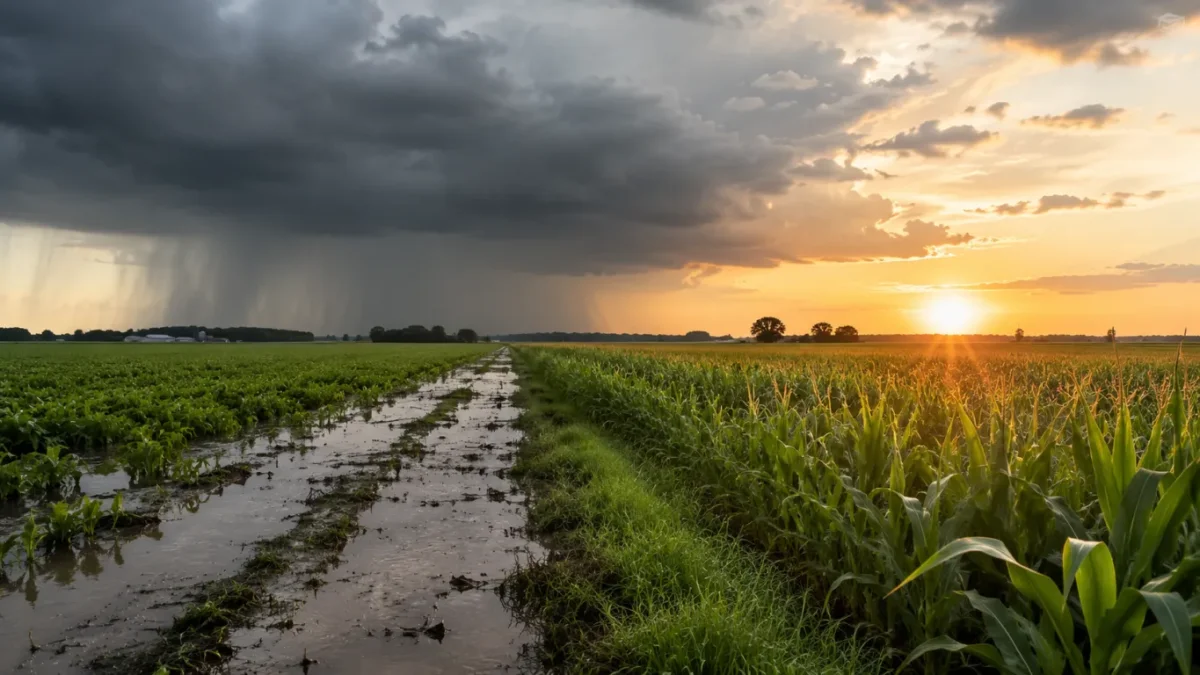
Yet farm flooding is rewriting field-level math. Some locations received excessive precipitation, causing flash flooding, saturated soils and delays in planting, spraying and nitrogen side-dressing. Southwestern Missouri was among the hardest-hit areas, with overnight totals locally reaching 76–178 mm (3–7 inches). In Kansas City, repeated heavy-rain rounds keep rivers and low ground on flood watch while producers weigh whether ponded corn and soybeans will recover or need replanting.
DTN Ag Meteorologist John Baranick warns that overlapping storm systems east of the Rockies could deliver more Corn Belt rainfall this week — welcome on recent dry pockets, dangerous where soils are already saturated. “The bigger concerns might be with the potential for severe weather and flooding,” he wrote on 10 June, pointing to Missouri and surrounding states as areas where additional rain could trigger significant flooding.
Plains hail damage and damaging winds
While the eastern Corn Belt wrestles with water, the northern and central Plains faced a different severe weather hazard. Thunderstorms swept eastern Montana and the Dakotas, producing hail up to 76 mm (3 inches) in diameter and wind gusts of 97–145 km/h (60–90 mph), according to USDA summaries. Heavy rain also raised flooding concerns in southeastern Kansas.
Hail damage at that scale can shred corn leaves, strip soybean pods and destroy yield potential within minutes — losses that surface in crop-insurance data weeks later rather than in daily headlines. Moisture remains broadly beneficial for rangeland and pastures, but violent storms are delaying harvest and fieldwork across Nebraska, Kansas and the Dakotas, adding uncertainty to regional yield forecasts and Chicago Board of Trade pricing.
Extreme heat, wildfire risk and the western split
West of the Rockies, conditions diverge sharply. The Southwest endures intense heat, low humidity and gusty winds, elevating wildfire risk on drought-stressed rangeland — a compounding threat for ranchers and irrigated districts. The outlook highlights a strengthening ridge driving unusually hot weather across the Desert Southwest and interior California, with triple-digit heat challenging daily records and raising heat-illness risk for outdoor farm labour.
Portions of the Northern Rockies and Pacific Coast saw cooler temperatures, with isolated frost at higher elevations — a reminder that June can still deliver late cold snaps. For traders, the national map is three simultaneous regimes: too wet in the middle, too violent on the Plains, and too hot and dry in the Southwest.
Climate-driven crop failure risk in global breadbaskets
The June Farm Belt squeeze arrives as researchers quantify longer-term food security risk. The report Global Breadbaskets: Food System Resilience as a Strategic Imperative warns that climate change is increasing the likelihood of crop failures in the American, European and Asian breadbaskets that produce most of the world’s wheat, rice and maize.
Compared with 2010 threat levels, the analysis projects that by 2040 the risk of a given year’s crop failing could grow roughly twofold for Indian wheat and German maize, threefold for French wheat, fourfold for French maize, and sixfold for Indian rice. Lead author Tom Ellison noted that “global breadbasket failures could strain NATO priorities, prompt unrest in key countries, and upend trade relationships” — a reminder that U.S. corn and soybean exports sit inside a tightly linked global grain system.
Extreme heat also threatens farm labour and transport infrastructure, not just standing crops. The report projects that by 2040 southwestern France could average up to 16 additional days per year above 35°C (95°F) — thresholds that cut yields, degrade grain quality and raise heat-stroke risk for workers. Similar heat-stress logic applies across the U.S. Farm Belt when humid 32°C+ (90°F+) days stack during pollination and pod fill.
Pennsylvania farm flooding: when spring floods hit growing season
East of the Corn Belt, Pennsylvania farm flooding shows how climate-driven rain timing — not just totals — reshapes operations. At New Morning Farm in central Pennsylvania, Jennifer Glenister grows organic produce for farmers markets — “everything from arugula to zucchini.”
Low-lying fields once flooded mainly in winter, when cover crops could hold soil in place. Now, Glenister says, floods sometimes arrive during the early growing season and destroy young vegetable plants. “I can plant another crop. I can’t replace the soil,” she says — underscoring how soil erosion from repeated flood events can permanently reduce productivity on flood-prone acres.
Her adaptation: grow fewer crops in low-lying fields and partner with neighbours on higher ground to source produce for market. The shift mirrors what USDA data already imply for commodity growers — retreat from the wettest bottomland, accept yield loss on saturated corn and soybeans, or invest in drainage and cover crops that build resilience before the next storm cluster.
Regional Farm Belt weather: Chicago, Des Moines and Kansas City
Three hubs show how differently Midwest crop weather is playing out:
- Chicago (Great Lakes): Chicago sits downstream of thunderstorm complexes tracking across Iowa and Wisconsin. An active mid-June pattern brings severe weather when cold fronts collide with Gulf humidity — damaging winds and flash flooding in urban drainage basins even when nearby fields still need rain.
- Des Moines (Iowa Corn Belt): Des Moines anchors a state where crop ratings remain strong but hail and wind reports from neighbouring systems keep insurers busy. Iowa often sets the tone for national corn yield expectations; widespread green snap or ponding here moves grain markets quickly.
- Kansas City (Missouri/Kansas): Kansas City lies near the bullseye of recent excessive rainfall and USDA flooding concerns. Producers south and east of the metro watch river stages and replant decisions on bottomland corn and soybeans while hoping drier days return before roots suffocate in saturated soils.
More rain ahead — what grain markets watch
USDA meteorologists expect an active pattern to persist. Cold fronts and tropical moisture could deliver an additional 51–102 mm (2–4 inches) across the Mississippi Valley, Great Lakes and Interior Southeast — moisture that may lift yield potential on well-drained soils but raises flood risk, nitrogen loss and replanting needs on heavy clay flats.
Crop yields, livestock pasture, crop insurance claims and farm profitability can all pivot on June weather. Markets often treat improving soil moisture as bearish for prices until hail, heat or a breadbasket-scale failure narrative reintroduces supply risk. With national good-to-excellent ratings still above 65% for both crops, the 2026 season has not tipped — but the window for stress is wide open, and long-range climate analysis suggests failure odds are climbing, not falling.
Track Farm Belt weather and crop conditions on SatMeteo
Because thunderstorm timing, hail swaths and river flooding shift hour by hour, rely on short-range hourly forecasts rather than week-ahead averages. Compare corn and soybean crop weather across the Midwest: check Chicago for Great Lakes storm complexes, Des Moines for Iowa field conditions, and Kansas City for Missouri-Kansas rainfall and flood risk. Use the live temperature map to monitor heat building in the West and humidity pooling ahead of the next Farm Belt severe-weather outbreak.